

















AI-powered requirement translation and rewriting within Azure DevOps
The shift from manual to AI-led requirements transformation
The Old Way
- I copy the Azure work item content to the translator app, translate it, then paste it into the work item.
- I spent lots of time reading long work item descriptions.
- I manually convert long raw work item content into a structured one.
- I spend hours manually writing extra notes for work items to share with junior team members.
The New Way with Transform
- I use Copilot4DevOps to translate work item content in 40+ languages using AI, directly within Azure DevOps.
- I use the Summarize feature to get a summary of long documents or work items and understand goals quickly.
- I use AI within Azure DevOps to convert work item content into bullet-point style.
- I pick “Elaborate" to expand particular Azure work item content using AI.
What is Transform in Copilot4DevOps?
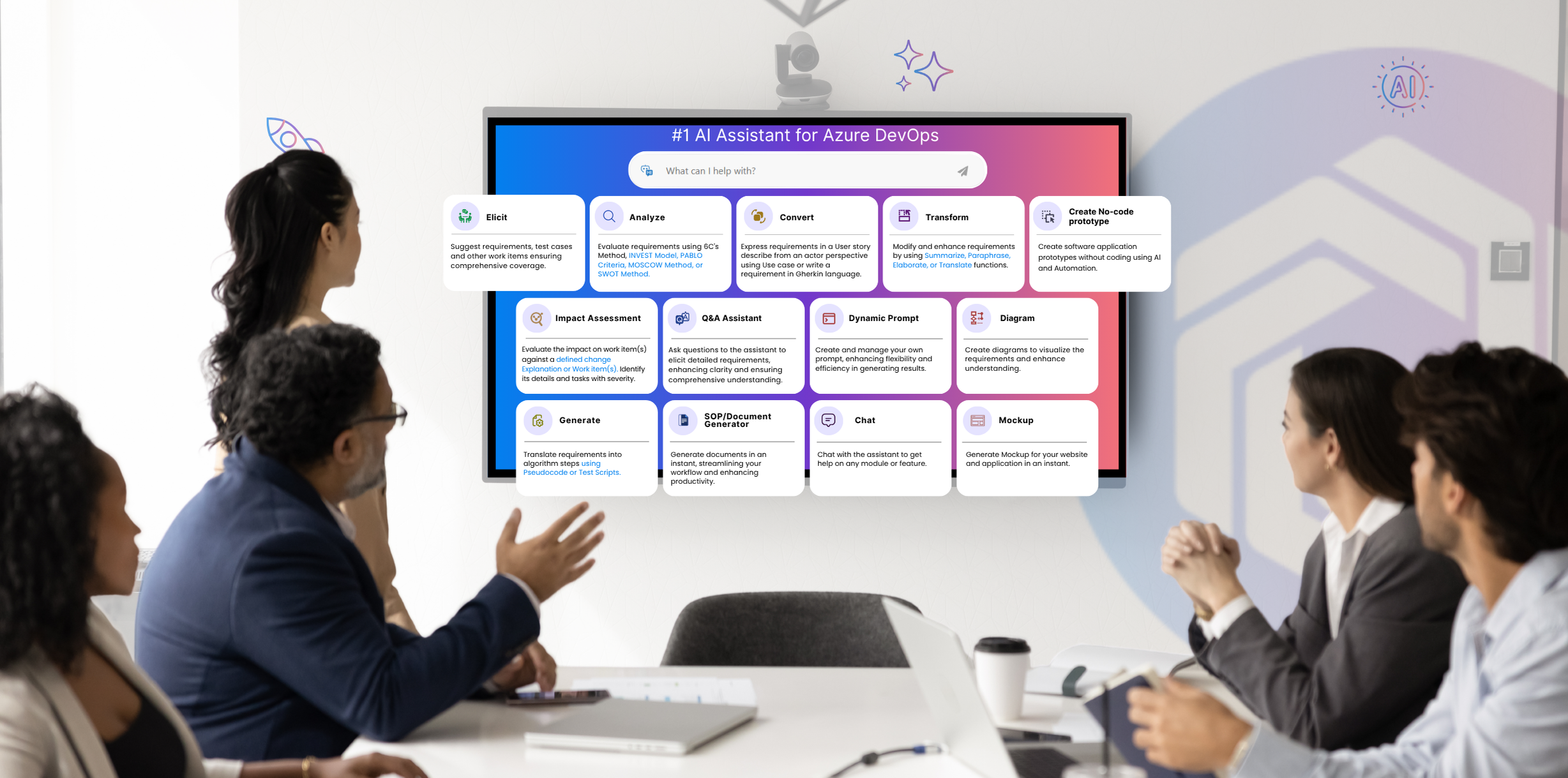
The Transform feature in Copilot4DevOps helps teams in enriching the text content of Azure work items by rewriting, shortening, or translating it using AI. It makes every task easier to read and share, saving hours spent cleaning up text or explaining details to others.
Whether you need a quick summary for a meeting, a detailed work item description for junior engineers, or a translation for global teams, Transform keeps everyone on the same page without leaving Azure DevOps.
Made for Every Role: Transform Work Items Your Way
Business Analysts
Rewrite existing requirements into paragraphs or bullet-point style format with AI to make them clear and structured.
Product Owners
Use Transform to translate existing Azure work items into a different language using AI before sharing with global team members.
Developer
AConvert complex acceptance criteria into bullet points and insert them into the Azure work item. So, you can break down each task into smaller ones and make a checklist to track which are completed and which are pending.
DevOps Engineer
Expand short operational notes or documents into the expanded deployment steps so that fellow team members can follow and understand the full context of tasks.
Test Engineer
Use AI to generate expanded test cases and acceptance checklists from existing Azure work items so you can jump straight into verification and reduce defect churn.
Scrum Master
Generate summaries of work items to quickly understand project goals and progress.
UX Designer
Take client feedback on designs and use AI to elaborate on feedback into proper requirements and task steps.
Security Engineer
Summarize long security requirements to quickly understand the security goals. Then, maybe translate the security requirements into another language before assigning them to the team members working in different regions.
4 ways to transform your Azure work items using an AI
Translate
Need to share work items or reports with global teams?
Use “Translate” to convert work items, documents, or reports into 40+ supported languages, including German, French, Arabic, Chinese, etc. It keeps the original text and work item structure intact. Once work item content is converted to another language, you can directly insert it into the same Azure work item.
Paraphrase
Need to restructure the work item content?
Use the “Paraphrase” option to rewrite existing work item content in a cleaner structure. With that, you can either paraphrase the content in paragraph format or bullet-point style format and replace the existing content of work items with newly generated content.
Summarize
Want a quick summary of long work items or documents?
Use the “Summarize” option within Transform to get a summary of existing Azure work items, documents, compliance reports, etc., directly within Azure DevOps. It helps teams to review work items and understand goals quickly. This AI-generated work item summary can also be inserted into Azure DevOps.
Elaborate
Want an elaborated version of work items to share with team members?
Use the “Elaborate” option to expand brief or short work item descriptions into detailed and easy-to-understand ones using an AI. It helps in adding missing context, a quick overview, purpose, significance, main aspects, key criteria if there are any, etc., to an existing Azure work item.
Solving everyday challenges across industries
Turning complex engineering specs into clear requirements in the Automotive sector
In the Automotive sector, engineers often deal with complex requirements. Sometimes, it even becomes hard for them to understand what the requirement is conveying, and they spend hours or days on that.
With Copilot4DevOps, teams can use the Transform features that allow them to summarize work items using AI. Then, engineers can quickly look at the summary and understand the requirements and goals. These requirement summaries also help stakeholders and testers quickly review the requirements.
While using Transform, teams can also paraphrase requirements into paragraph or bullet point format. This converts requirements into a structured format, and it becomes easier for engineers to understand complex requirements.
Keeping global teams in sync in IT & Software development
In large IT companies, multiple teams across different countries might work on the same project. Also, if offshore developers are involved in the project, they prefer to work in local languages. So, if the product owner writes a work item in a particular language, such as English, then developers don’t understand the project goals. This can slow down the application development and launch.
In such a scenario, teams can use the Translate feature of Copilot4DevOps to translate Azure work items in 40+ languages using AI. Even these translated texts can be added to the Azure work item and shared with global team members working from different regions. This way, teams don’t need translators, cutting costs and saving time.
Elaborate on domain-specific requirements for tech teams in Healthcare
In healthcare projects, clinical experts and product owners work together to prepare requirements for medical devices, software, etc. However, they write requirements in domain-specific language that technical teams might not understand. Due to this, there are very high chances of miscommunication, which could introduce new risks and project delays.
With Copilot4DevOps, teams can elaborate Azure work items using an AI. Project managers can elaborate short clinical notes, feedback, etc., into a detailed version that contains a quick overview, key aspects, criteria, and purpose. Later, managers can directly add this elaborated version to the existing Azure work item and share it with technical team members. This ensures that everyone from different teams understands the requirements properly and they are on the same page.
Real outcomes teams see once they start using Transform
- Reduces manual work: As AI does heavy lifting, teams don’t need to manually write document summaries, reword work items, or translate into another language.
- Save time: Teams that use Copilot4DevOps save 90% of their time in work item translation and rewriting.
- Accelerate decisions: AI-generated summaries of work items help stakeholders to make informed decisions quickly.
- Aligns global teams: AI translation helps in aligning global teams across multiple regions. It ensures every team member is on the same page.
- Cut rework before it starts: Elaborated Azure work items leave no room for confusion. Therefore, the team most often implements exactly what stakeholders need and reduces the rework by 80%.


