





Requirements management is no longer static and evolves each year. The way teams define, review, and manage requirements keeps changing with delivery models, tooling, and scale.
Also, AI is reshaping the overall requirements management space in 2026. Teams are moving beyond manual writing and reviews. AI is being used for requirement elicitation, quality checks, impact analysis, prioritization, and change assessment across the lifecycle.
To stay ahead, organizations have already started adopting AI in requirements management at scale. The proof of that is: A global survey on AI for Requirements Engineering reports that 58.2 percent of teams already use AI in RE, and 69.1 percent rate its impact as positive or very positive.
So, let’s explore how AI is reshaping requirements management in 2026.
Top AI Trends Shaping Requirements Management by 2026
1. AI-Driven Requirements Elicitation and Drafting
AI is changing how requirements are captured for any project. AI tools allow for converting meeting notes, call transcripts, raw documents, or text into well-structured requirements. Furthermore, AI also allows teams to edit existing requirements with natural language instructions.
This reduces the manual rewriting and speeds up early alignment. Analysts focus more on intent and validation instead of formatting and cleanup.
2. AI-Based Requirement Quality and Consistency Checks
In 2026, AI will not only be used for drafting requirements, but it will also make requirements review seamless. AI tools can check clarity, duplication, and structure as requirements evolve.
This improves baseline quality across large backlogs. By using AI for requirements analysis, teams can reduce rework caused by unclear or inconsistent requirements entering development.
3. Predictive Impact Analysis for Requirement Changes
Change in product development is constant, but its impact is often unclear. AI can analyze linked work items, such as user stories, test cases, tasks, and other dependencies, and assess how a change can affect those.
With this, teams can judge whether a change is safe, risky, or requires wider coordination. This is critical for large programs and regulated environments.
4. Compliance-Aware Requirements Management
In regulatory industries, such as healthcare, defense, banking, government, etc., it is a must to align requirements with compliance. AI can assist teams by identifying compliance gaps early and mapping requirements to relevant standards or controls. This reduces last-minute corrections and improves traceability confidence.
5. AI Governance, Auditability, and Explainability
Governance is non-negotiable when AI is used to make important requirements decisions. AI outputs should be reviewable, traceable, and reversible. This includes version history and clear links to original inputs.
6. AI-Enabled Prototyping from Requirements
AI tools are now used to create a quick prototype of applications from existing requirements. Teams can generate mockups, flows, or requirements diagrams from the text and share them with stakeholders to validate product ideas quickly.
7. AI-Enabled Document Generation
On the other hand, AI now creates well-structured requirements documents, including SOPs, functional specs, SDDs, PRDs, etc., that might contain subheadings, requirements diagrams, step-by-step points, etc. AI tools take existing requirements as context input and ship a clear document within minutes that complies with regulatory standards.
8. AI-Based Requirements Translation for Global Team Alignment
In large projects, multiple teams work together across the globe. Different teams might speak and write different languages. AI is now helping teams to translate requirements into multiple languages while preserving intent and structure. This reduces reliance on manual translation and avoids meaning loss during handoffs.
Together, these trends show how AI is reshaping requirements management at a practical level. Teams that adapt early will gain better clarity, control, and alignment as systems and expectations continue to grow.
Role of AI in Enhancing DevOps and Requirements Management
AI in DevOps is changing how requirements fit into modern product development practices. Instead of treating requirements as a static input, teams can now manage them as a living asset that evolves with a continuous delivery cycle.
For DevOps teams, AI helps in keeping requirements in sync with frequent changes. When scope changes, teams can instantly use AI to quickly update requirements descriptions, acceptance criteria, etc., without slowing down sprint execution. This helps in reducing the friction between planning and delivery teams.
Other than that, AI also helps the execution teams, including development and operations teams, by automatically generating pseudocode and test scripts from requirements text. This shortens the development time and makes the release cycle smoother.
Another impact is on coordination across the delivery pipeline. AI helps maintain alignment between requirements, development tasks, and validation work as they change over time. Teams gain clearer visibility into what is ready, what is blocked, and what needs attention.
By 2026, AI will not replace DevOps practices. It will strengthen them by keeping requirements active, connected, and usable throughout delivery.
Challenges and Risks of AI in Requirements Management
Of course, AI offers clear benefits in requirements management, but it also includes new risks that teams need to address. Here are some of them:
- Security exposure of sensitive inputs: Requirements often contain sensitive data, business rules, and other critical information about the organization or product. So, if you are using external AI tools, you must know how they process internal data and what security risks are associated with using the tool.
- Compliance misalignment risks: AI tools might not follow industry-specific compliance rules while drafting requirements or generating documents. So, it is a must to provide proper instructions to AI to fill these gaps.
- Over-reliance on AI suggestions: Note that no AI tool is 100% perfect. AI might make some assumptions and produce wrong outputs or miss edge cases. So, teams should always ensure that humans review AI suggestions.
- Bias in training data: When AI models are trained on biased or incomplete data, they always generate biased output, which can influence requirement suggestions and prioritization.
- Inconsistent governance practices: AI tools are machines, and teams are required to provide proper information about organization policies, requirements, document structures, etc. If this is not done properly, it generates inconsistent output.
While using AI for product development, tackling these challenges is not optional. So, teams should choose an AI tool for requirements management that addresses all these challenges.
How Copilot4DevOps Enables the Future of AI-Powered Requirements Management
Copilot4DevOps is an award-winning AI assistant for requirements management that works within an organization’s Azure DevOps workspace. So, teams can directly start using AI in places where all their data is stored, and there is no data movement to external tools.
Copilot4DevOps is SOC Type II certified, which means it doesn’t use users’ data to train its model or expose it to other third-party service providers. This allows teams to use AI confidently while meeting security, compliance, and governance expectations.
Furthermore, it is trained to automatically follow specific compliance requirements when preparing requirements drafts or documents, helping teams align with regulatory standards. It also ensures that the generated output is not biased.
Here are the capabilities of Copilot4DevOps:
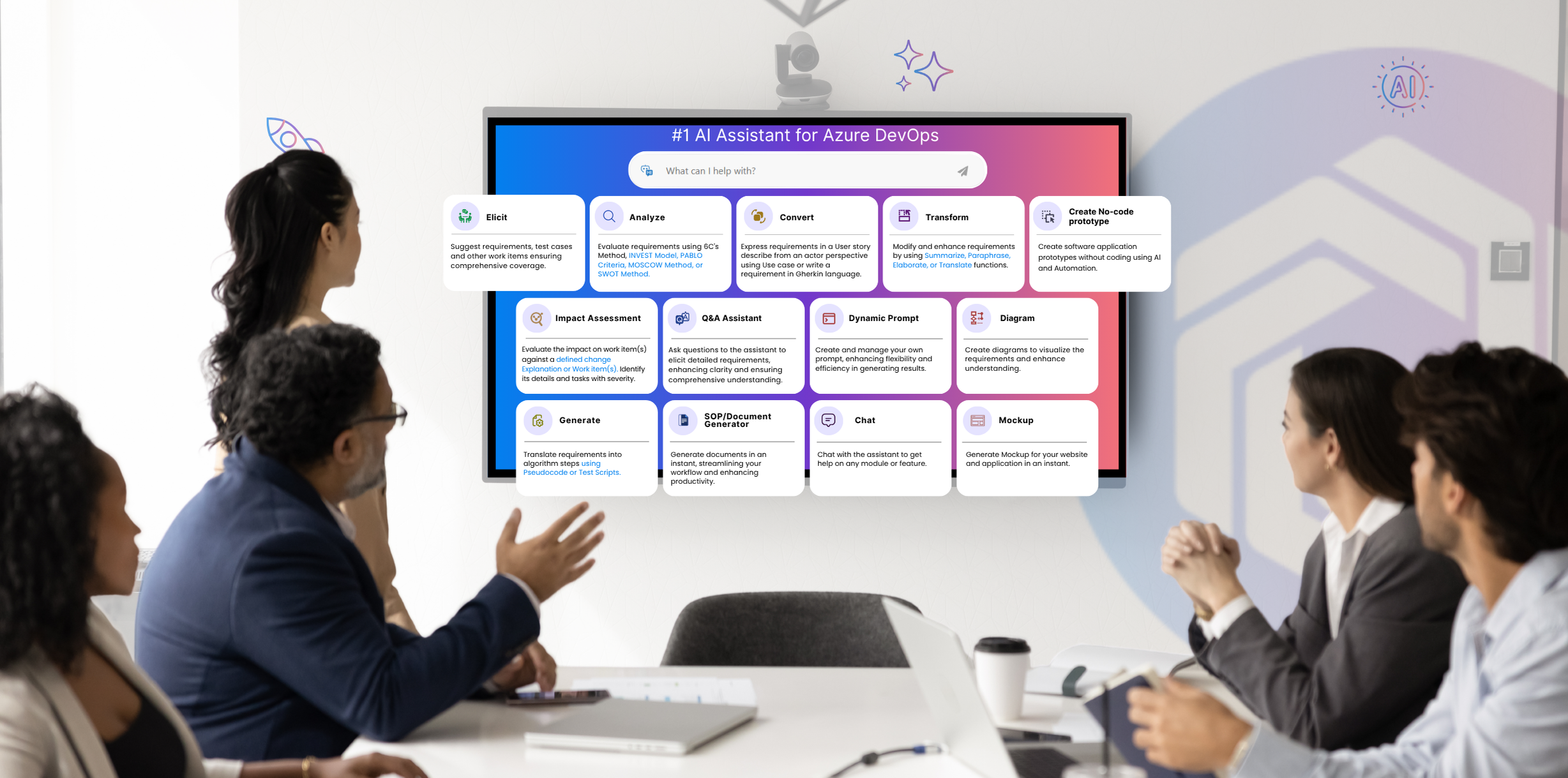
- Elicit: Draft requirements that align with compliance from raw input text.
- Analyze: Check the quality of requirements and ensure there are no compliance gaps.
- Impact analysis: Assess how a change in a particular work item will affect other work items.
- SOP/Document generator: generate different types of requirements documents by providing existing work items as a reference.
- Generate: Prepare pseudocode and test scripts based on the requirements’ acceptance criteria.
Other than this, Copilot4DevOps can also translate requirements into 40+ languages and generate requirements diagrams and mockups.
In short, teams that want to stay ahead of AI trends in requirements management should start using tools like Copilot4DevOps, which offer high security and accurate output that aligns with your compliance needs.
Try it Yourself
Ready to transform your DevOps with Copilot4DevOps?
Get a free trial today.