

























Interact with Azure Work Items Using Natural Language
See how AI Chat changes the way teams work in Azure DevOps
The old way
- I create every work item’s content manually and insert it one by one into the Azure DevOps.
- I update each work item manually.
- I search for a specific set of work items using long query filters.
- I manage Azure wiki pages from a different tab.
- I write requirements documents manually.
- I collect data to make project progress reports manually.
- I create requirements diagrams manually.
The New Way with AI Chat
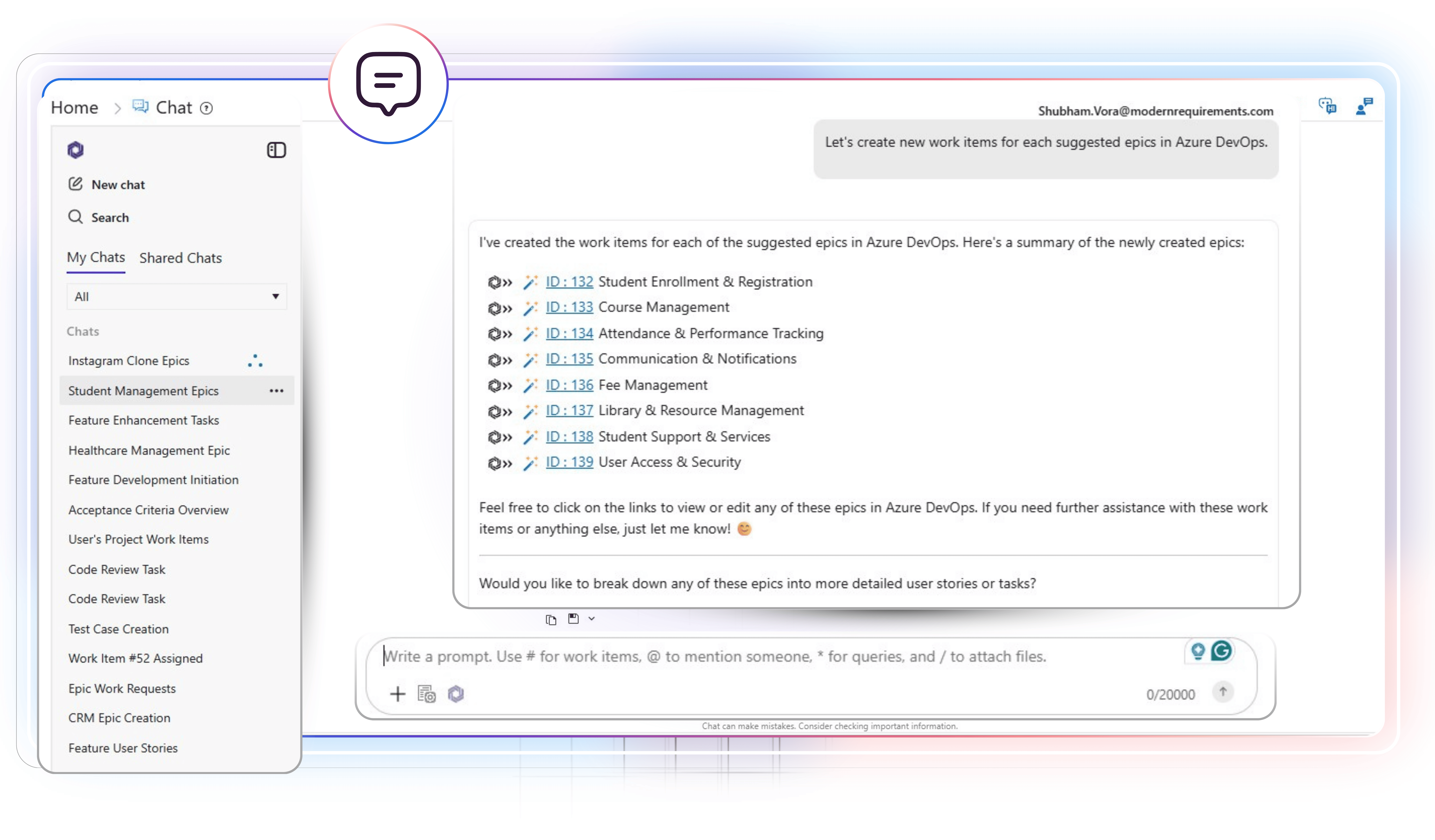
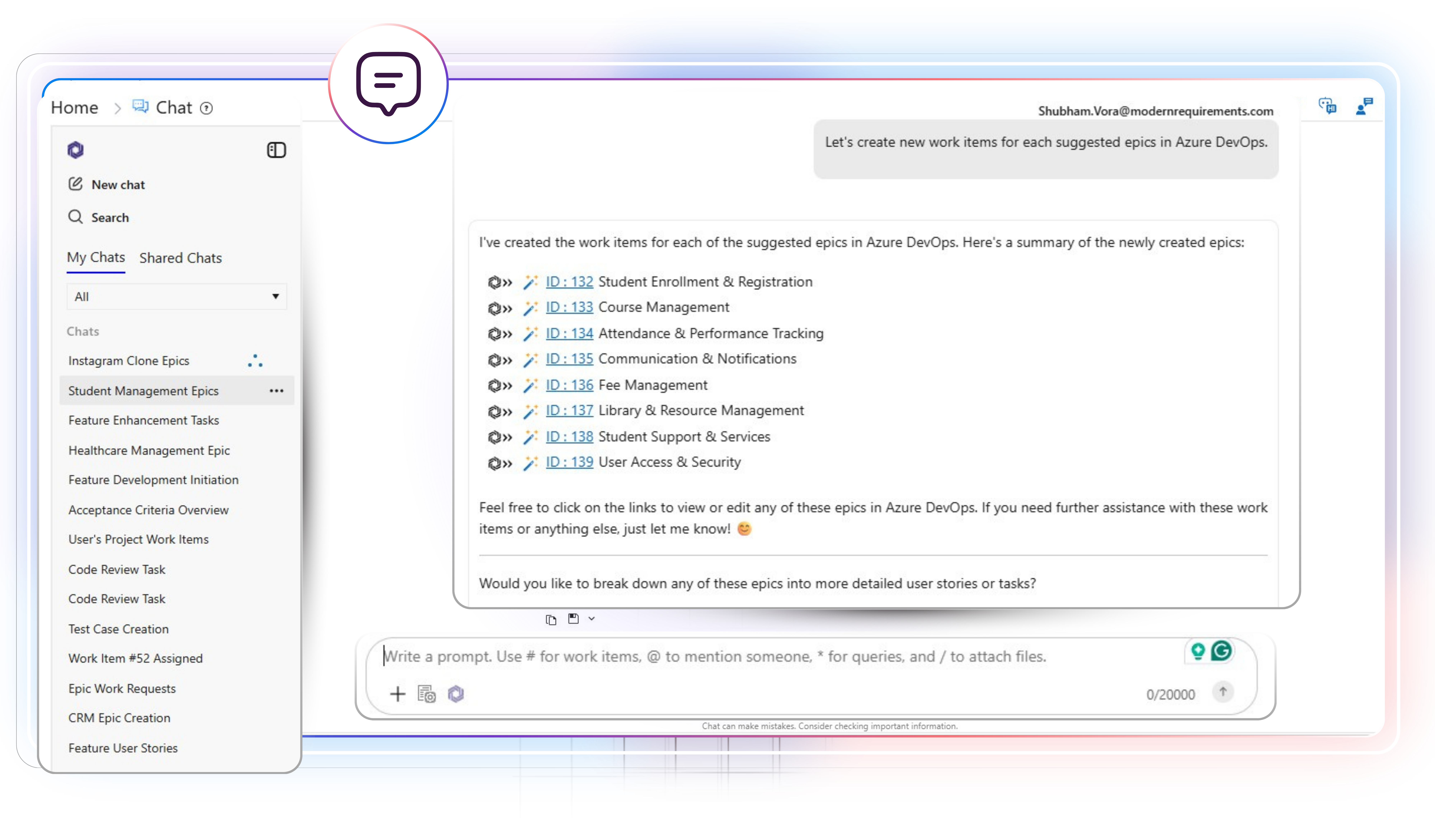
- I type a single prompt like “Create five user stories for the login module” and get them added within Azure Backlog instantly.
- I just type something like, “Change priority of all child work items of epic #122 to 1,” and AI updates all in bulk.
- I ask in plain language, like “Show all high-priority bugs in Sprint 8,” and AI lists all related Azure work items.
- I ask AI to create, edit, or delete wiki pages right inside the chat.
- I ask AI Chat to use particular Azure work items as a reference and prepare requirements documents accordingly.
- I use AI to generate summaries and progress reports instantly with one message.
- I write a prompt to generate any type of diagram in natural language and get it ready in no time.
AI Chat in Copilot4DevOps explained
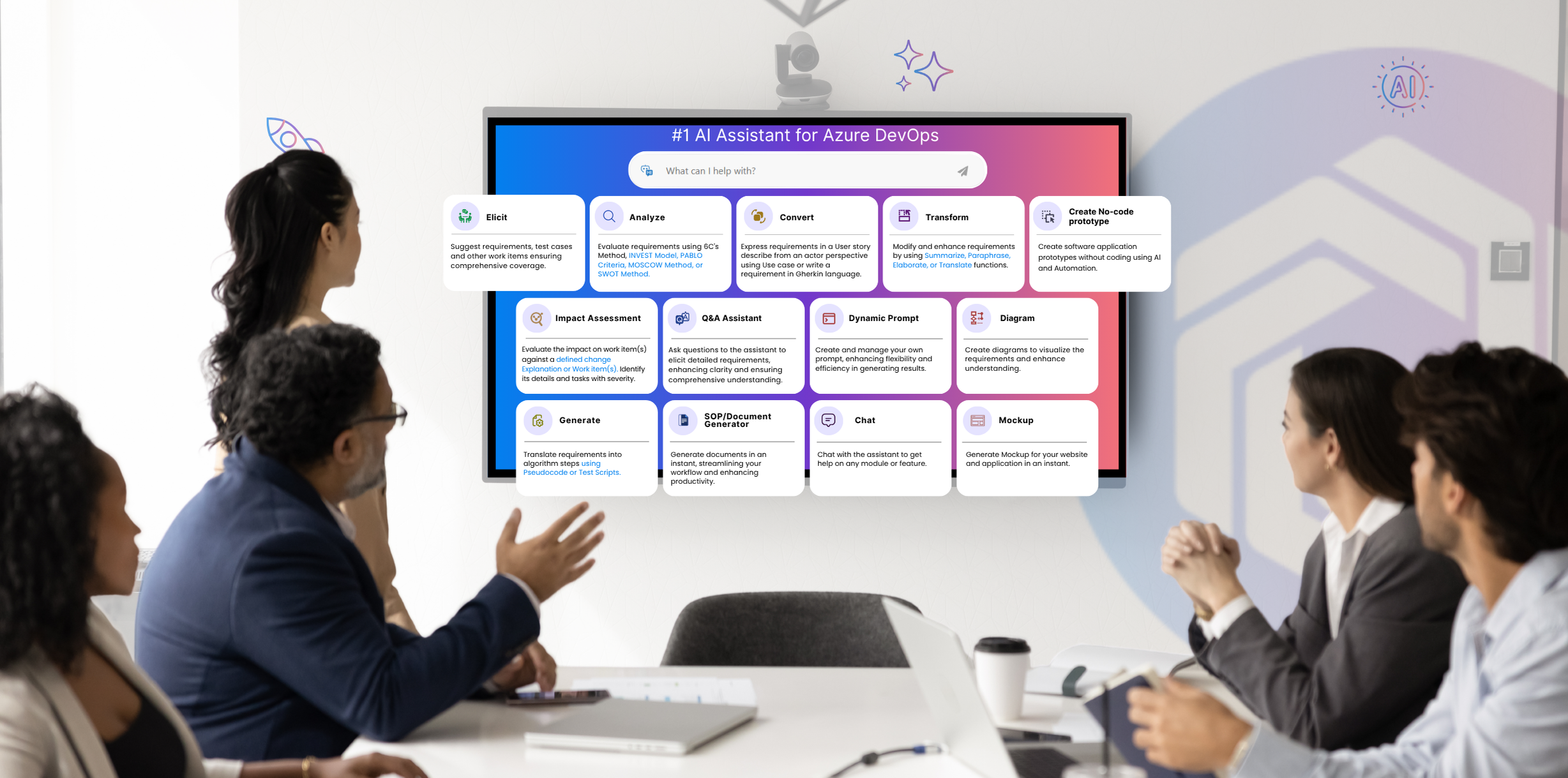
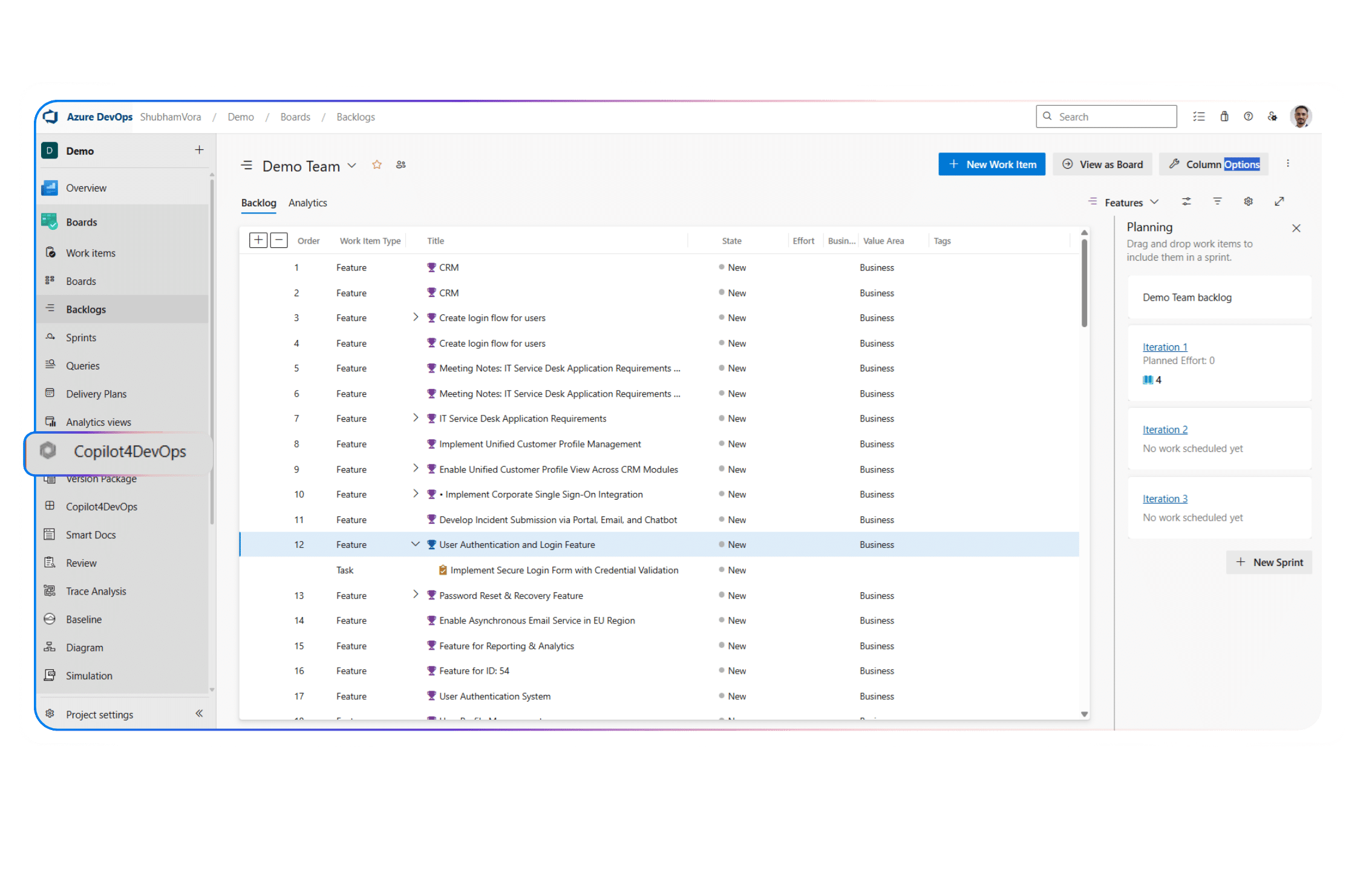
AI Chat is a key feature of Copilot4DevOps, which functions as an AI-powered assistant within Azure DevOps, enabling teams to manage their backlog using natural language prompts. It brings a simple chat interface where teams can act on work items, update details, delete them, or review project progress by getting work item summaries in one place.
With AI Chat, teams can quickly handle routine actions in bulk, build workflow diagrams, manage Azure wiki content, and generate requirements documents without switching screens. It helps reduce time spent on repetitive updates and keeps every project organized, consistent, and easy to track.
Teams working in different industries use it whenever they need formal documentation for audits, reviews, or project handovers. It saves time by turning raw backlog information into professional documents that follow standard formats and can be exported for review or submission.
Key Capabilities
Generate product requirements ideas using an AI.
Create work items like epics, stories, or test cases using a single prompt.
Inserts all AI-generated work items that you approve into the Azure Backlog.
Update work item fields like status in bulk without opening each item manually.
Generate queries to filter work items and save them within Azure DevOps for future use.
Build workflow diagrams in bulk based on selected work items in seconds.
Summarize all child items under any high-level work items, such as an epic, for quick progress checks.
Create and manage Azure wiki pages right from the chat window.
Generate requirement documents and reports with a single prompt.
Handle multiple chats at once and switch between them freely.
AI built for every role that works within Azure DevOps
Business Analysts
Turn meeting notes into epics and user stories using an AI. Ask for a gap analysis and clear acceptance criteria. Create linked work items inside Azure DevOps and concise summaries to speed grooming and cut rework across teams.
Product Owners
Use AI to capture product ideas and convert them into backlog-ready items. Use chat to prioritize features, set stakeholder-facing summaries, and keep scope aligned without long manual edits or back and forth.
Project Managers
Generate status snapshots, run quick queries for risks and blockers, and bulk update schedules or work item priorities of Azure work items. Produce stakeholder-ready reports from the backlog in minutes to save meeting time.
Scrum Master
Check sprint health, surface blocked work, and assign follow-ups from chat. Create quick retrospective actions and update team tasks so that daily standups focus on solutions rather than tracking updates.
Developer
Link code tasks to user stories, ask for clarification on requirements, and auto-generate simple test cases or implementation notes using an AI. Reduce context switching and speed handoffs between planning and coding.
QA Tester
Create test cases from user stories, run filters for failed tests, and request bug summaries. Bulk update test statuses and attach evidence without leaving Azure DevOps to speed release checks.
Solution Designer
Utilize AI to draft system diagrams from selected work items, request interface or data flow sketches, and attach generated visuals back to the backlog to make design reviews faster and clearer.
DevOps Engineer
Produce deployment checklists, map pipeline tasks to work items, and generate rollback steps from release notes without switching between multiple steps. Use chat to produce operational runbooks and keep deployment work traceable.
Release Manager
Prepare release notes, group related tasks, and set release priorities quickly. Perform bulk edits to tag and move items across sprints and communicate changes to stakeholders to keep releases on schedule.
Compliance Manager
Pull audit-ready traces, generate policy checklists for work items, and export linked evidence. Quickly identify gaps in required approvals, flag missing controls, and speed review cycles for regulated projects.
Technical Writer
Turn work items into user-facing guides, compile release notes, and generate SOP drafts with AI. Create linked documents from the backlog to keep manuals current with minimal manual formatting.
Key features of AI Chat that reduce the team’s workload
Quick access
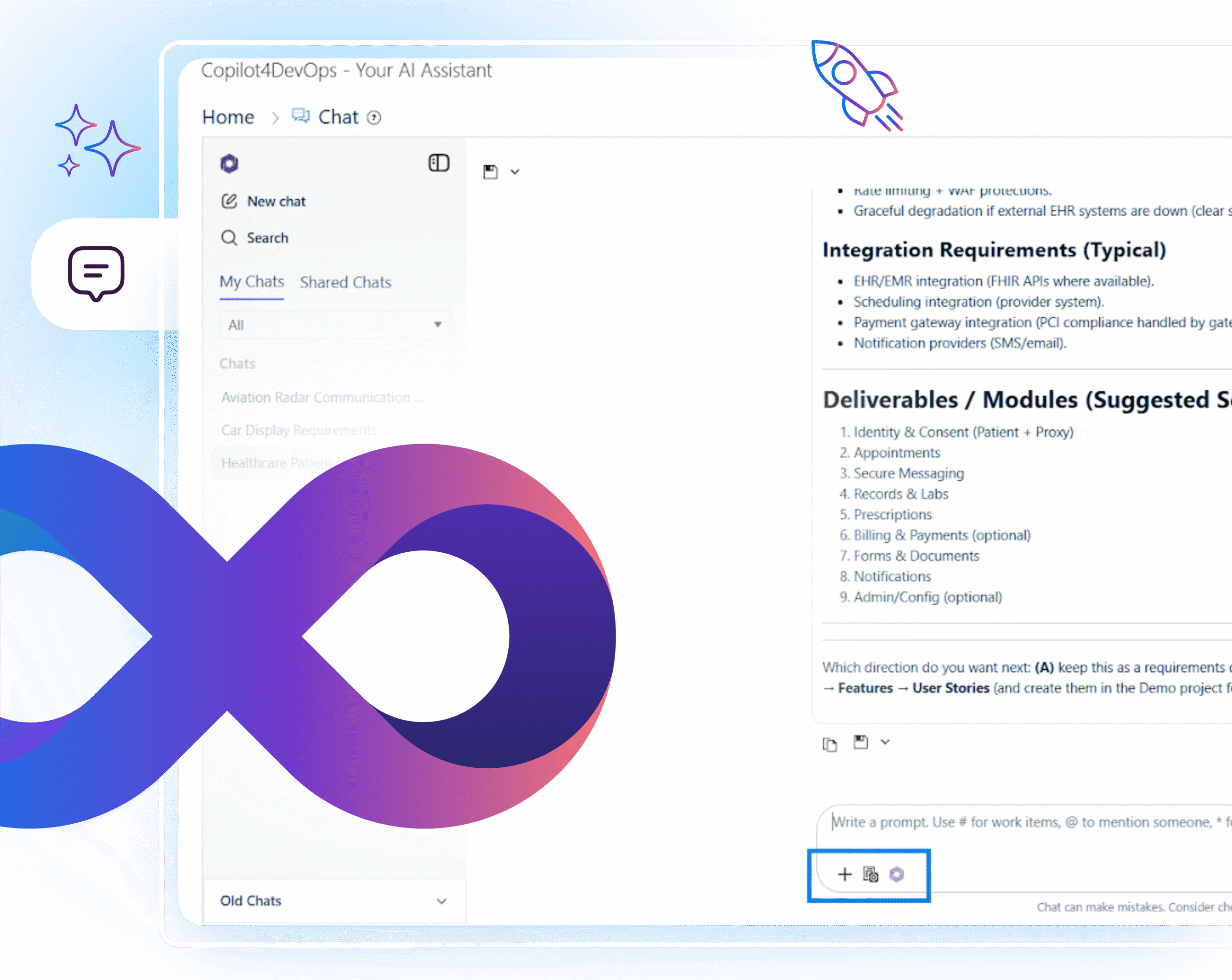
For instant use, you can open AI Chat directly from the Azure DevOps side panel. If you’re already working on a specific Azure work item, open Copilot4DevOps from that item to access AI Chat and continue the conversation in the context of the work item.
File upload
Need to provide context to AI while you ask it to perform any action?
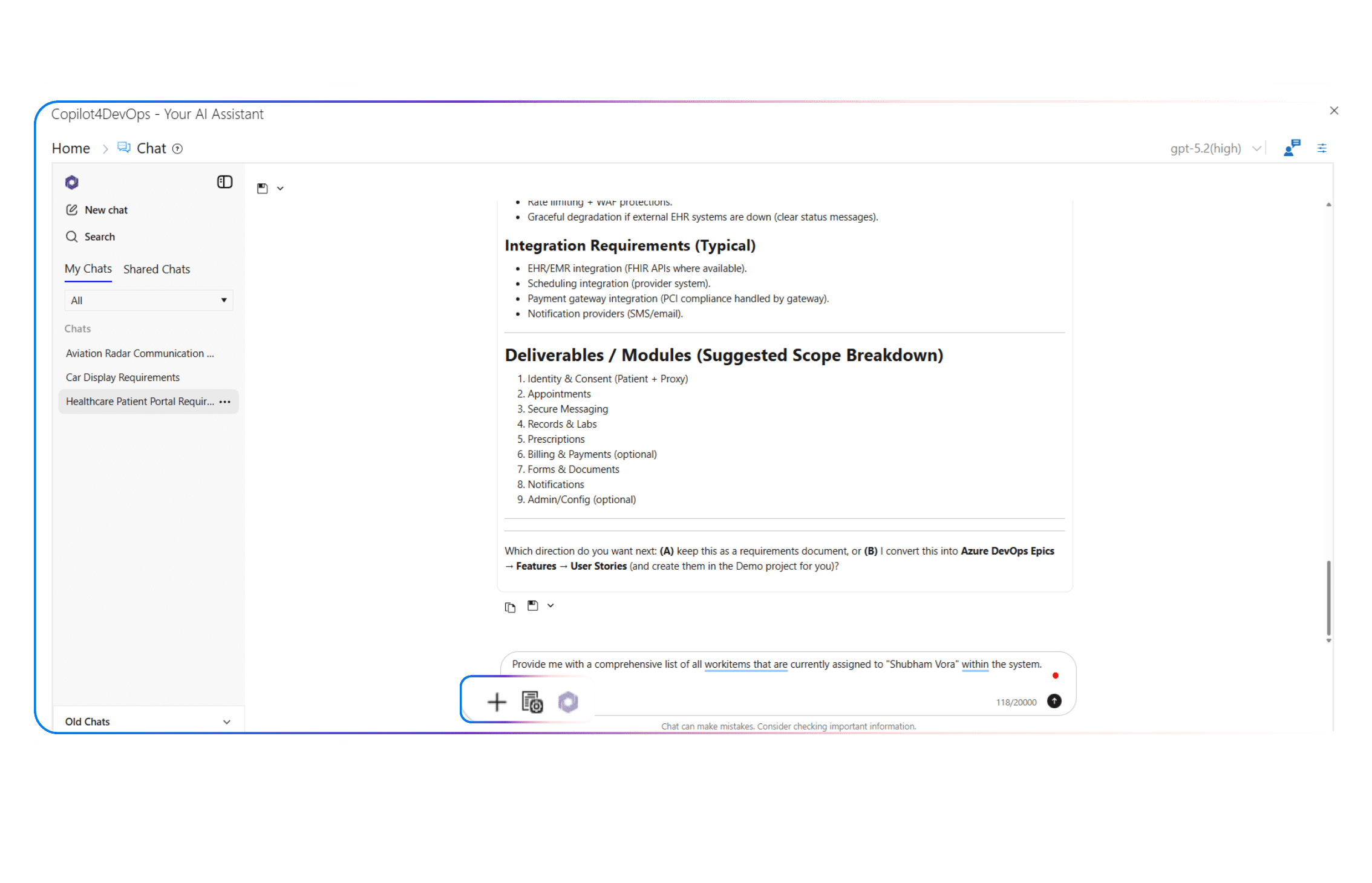
Just upload multiple files or paste images into the prompt area of the chat. It uses the content of files to generate a more accurate response.
For example, upload meeting notes, and ask it to create multiple epics for each high-level work item and add them within Azure DevOps.
Chat history and management
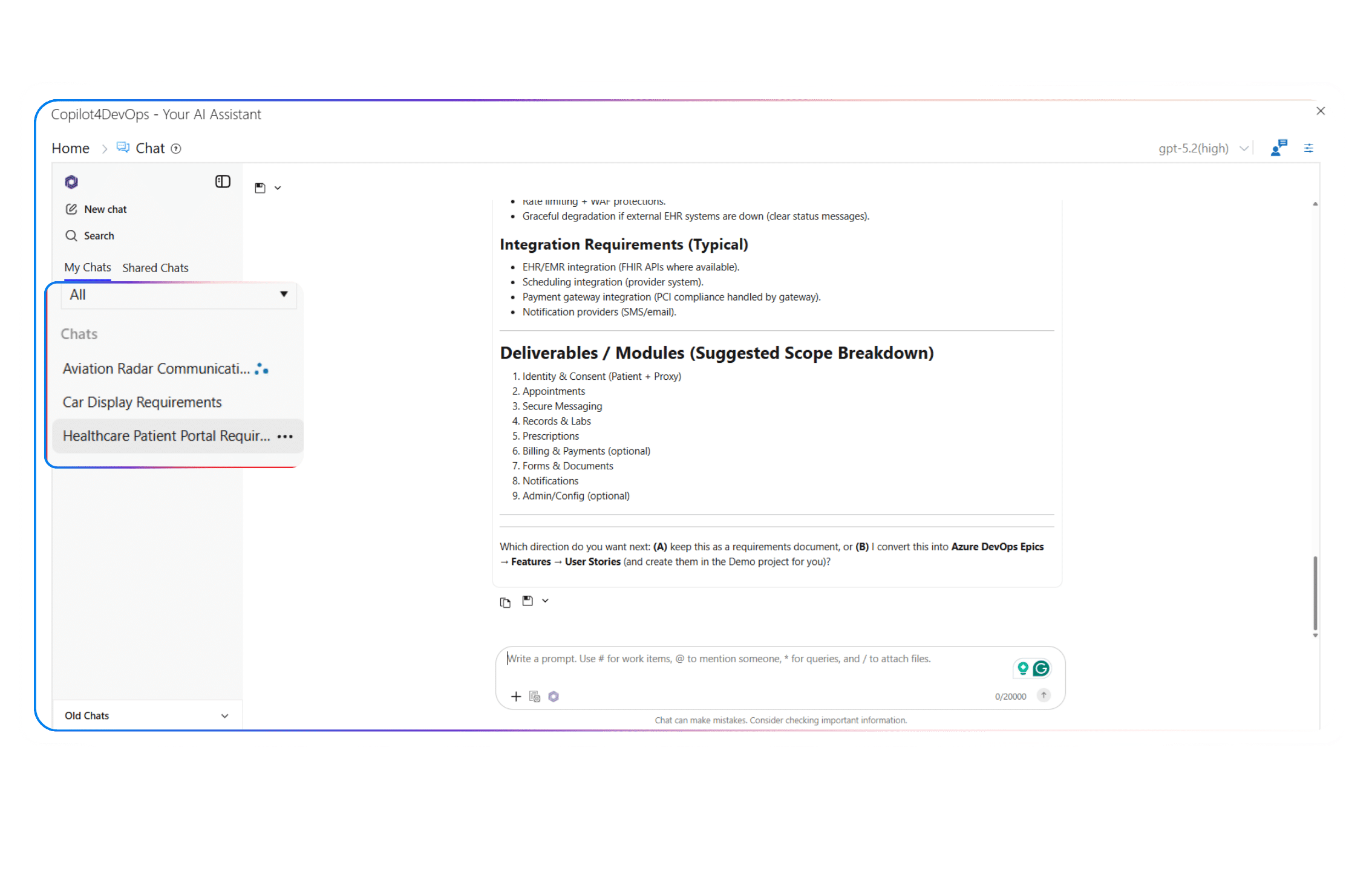
Want to access past chats?
You can access them from the sidebar and start interacting with them. You can even rename or delete chats.
Shared chats
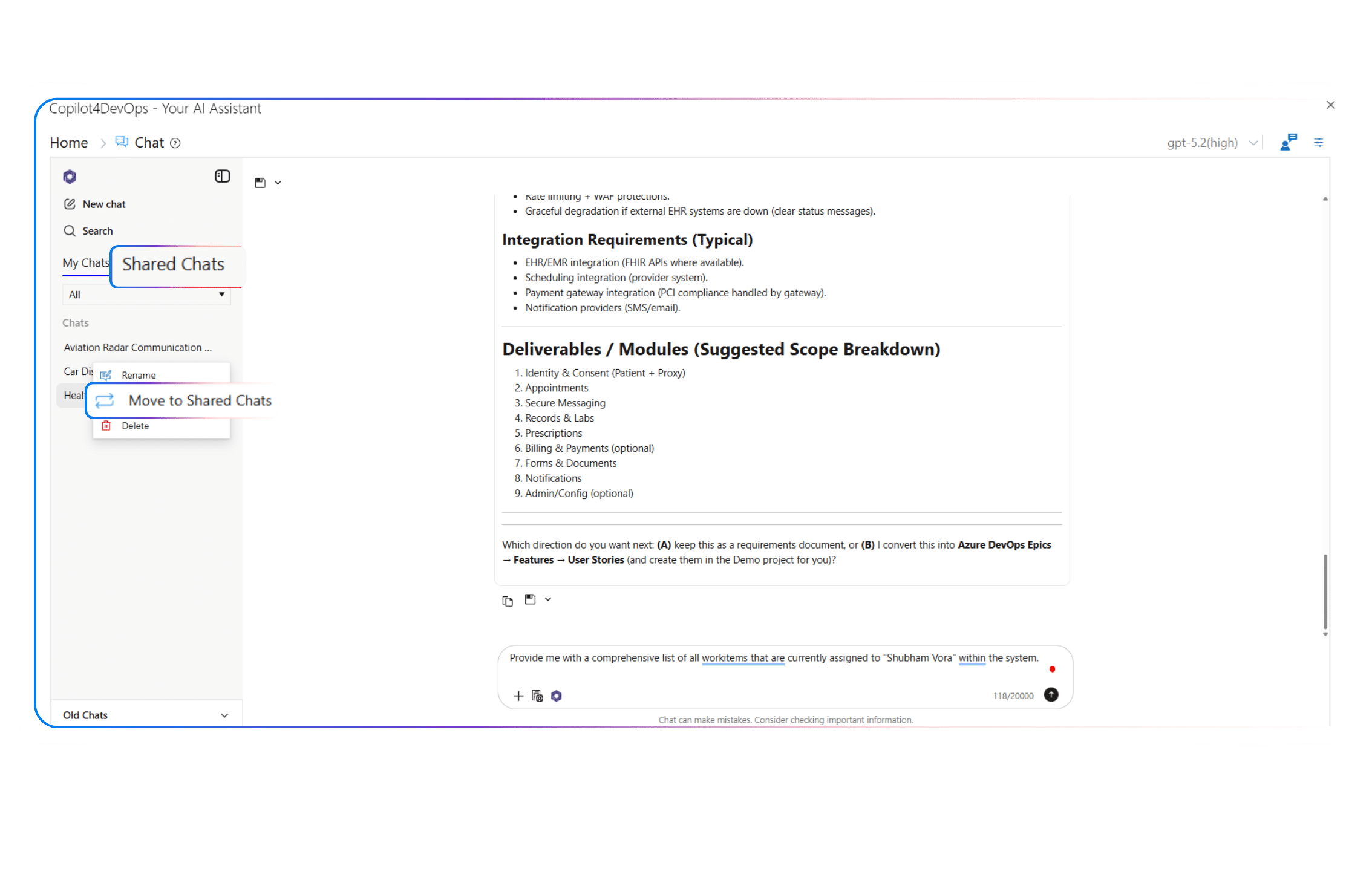
Need to share chats with your team members?
Move chats from the “My Chats” tab to “Shared Chats”, and your team members will be able to access and interact with them without starting from scratch.
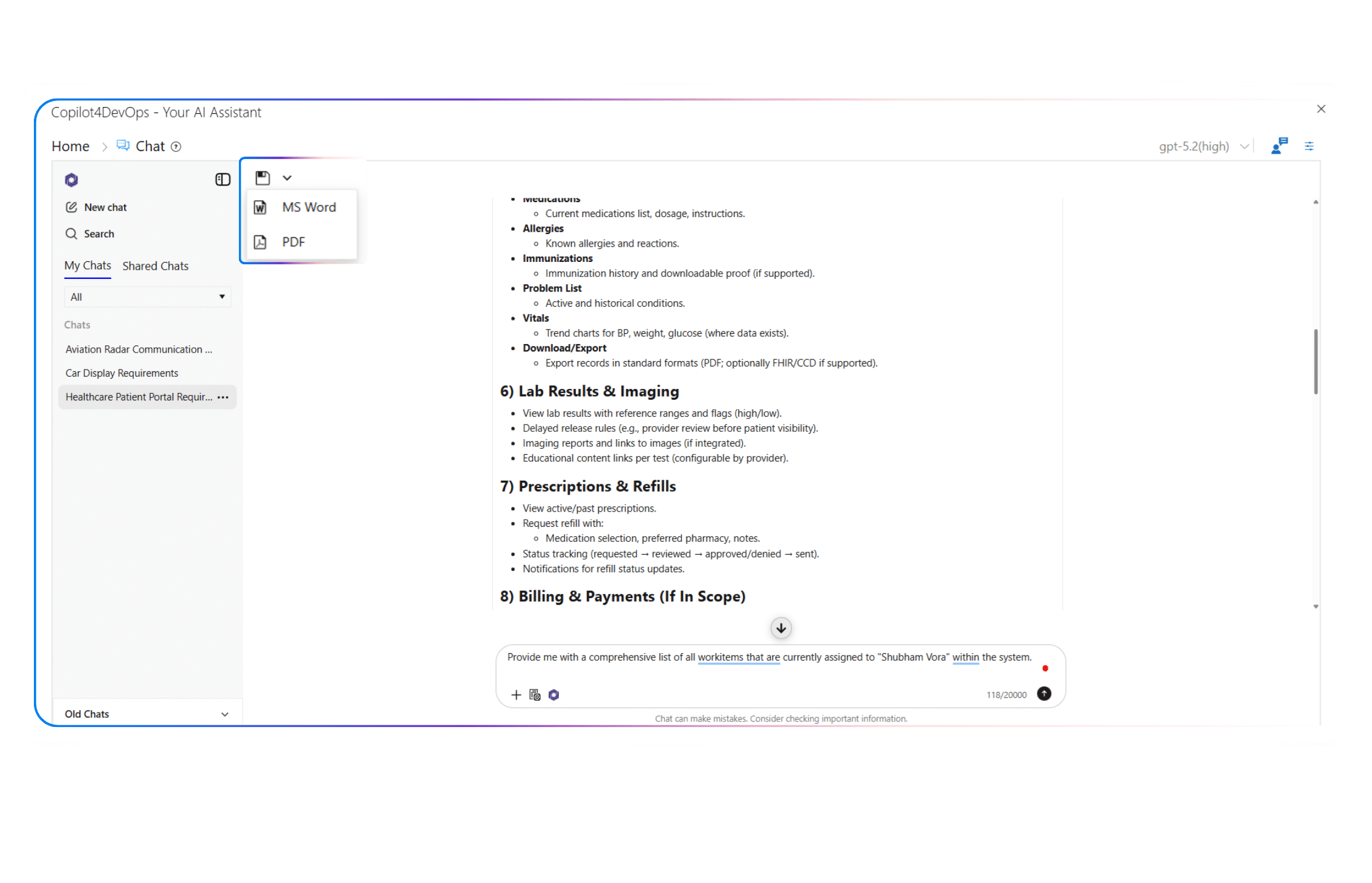
Export chats
Want to share chats with external team members?
AI Chat allows you to export the chat in Microsoft Word or PDF format.
Commands and shortcuts
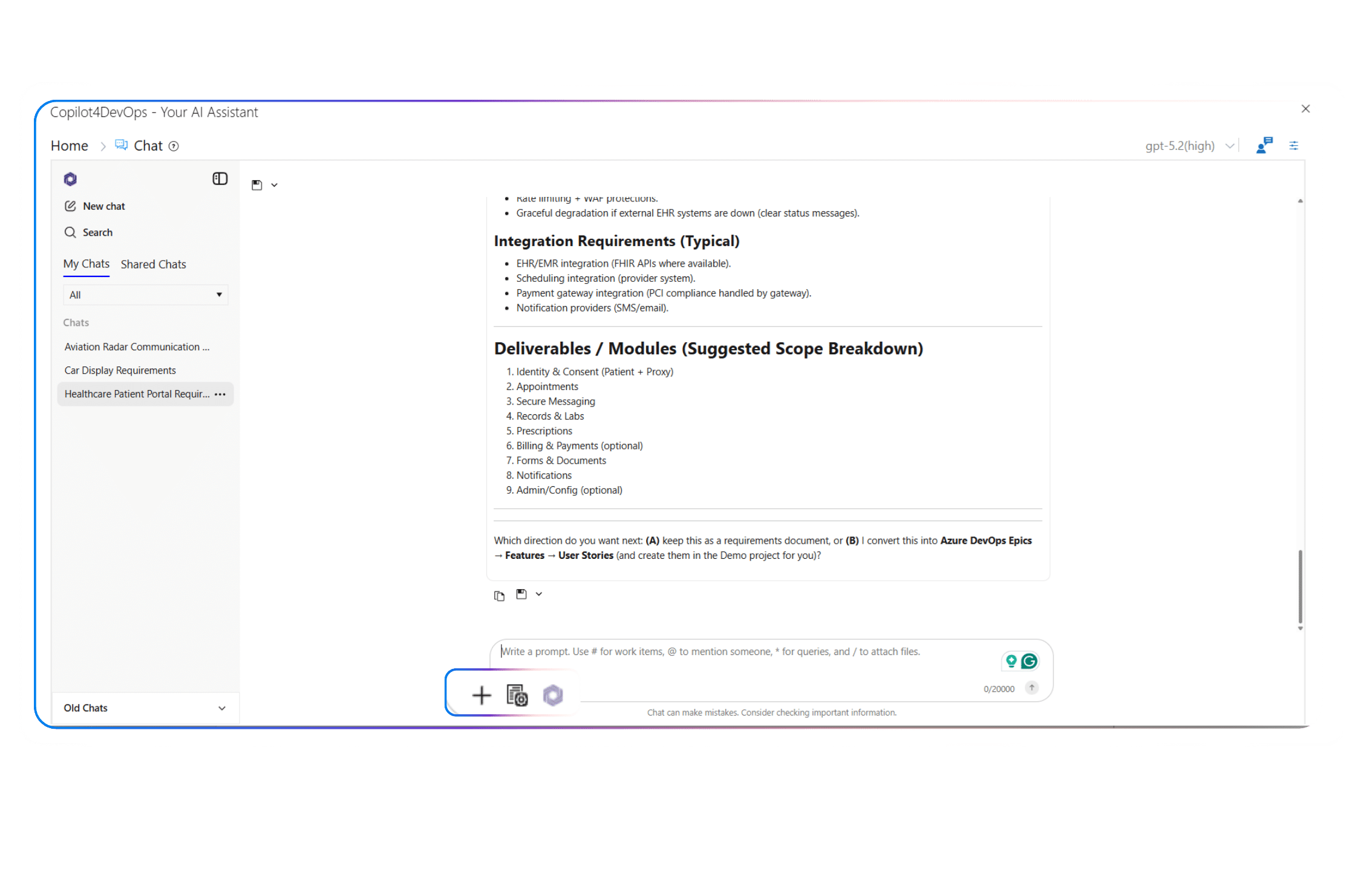
- Use “/” to attach internal files directly.
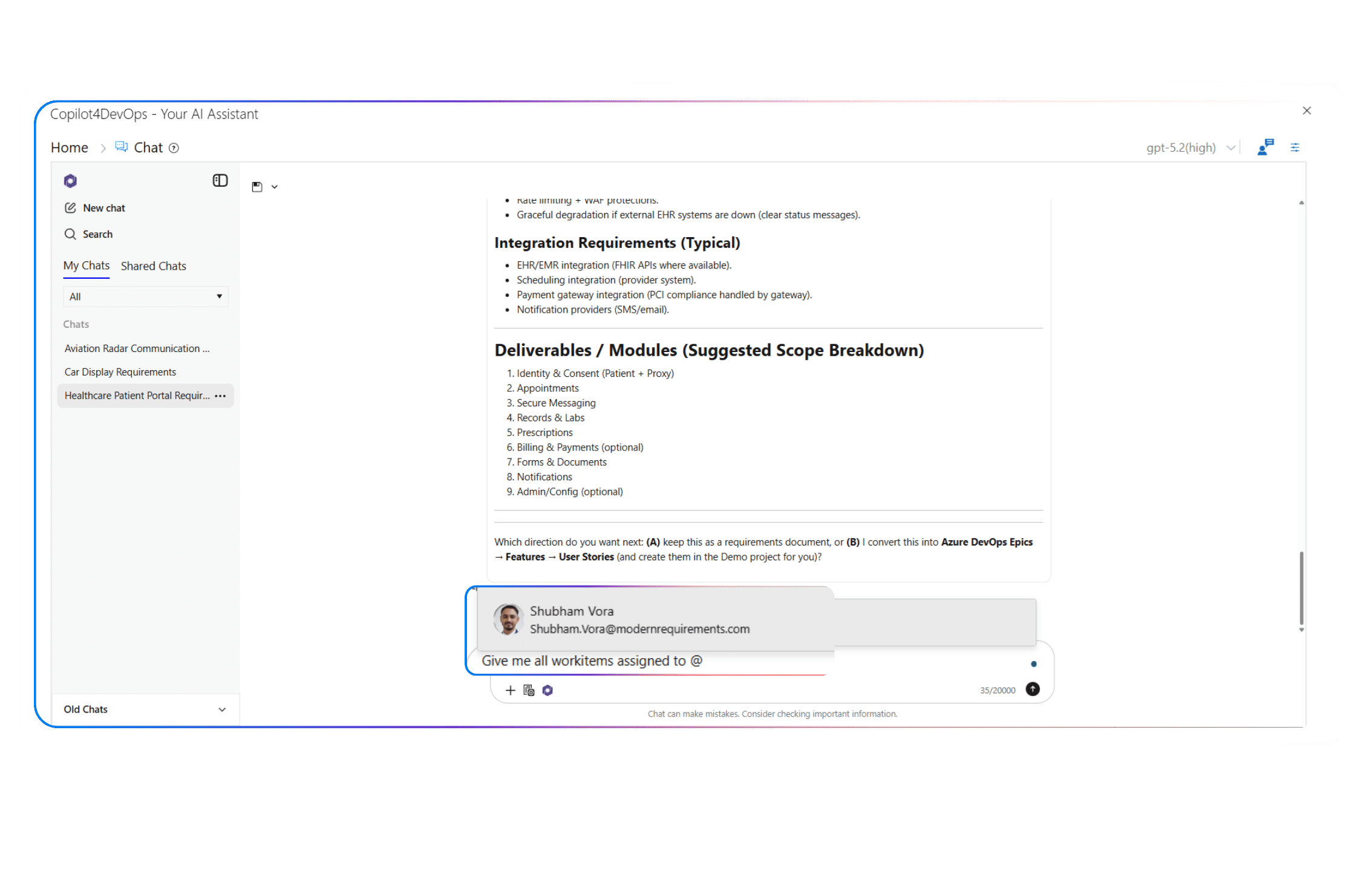
- Use “@” to mention a team member in the chat.
- Use “#” to reference any existing Azure work item.
- Use “*” to access saved queries.
Smart text reference
Need to link a part of your chat as context?
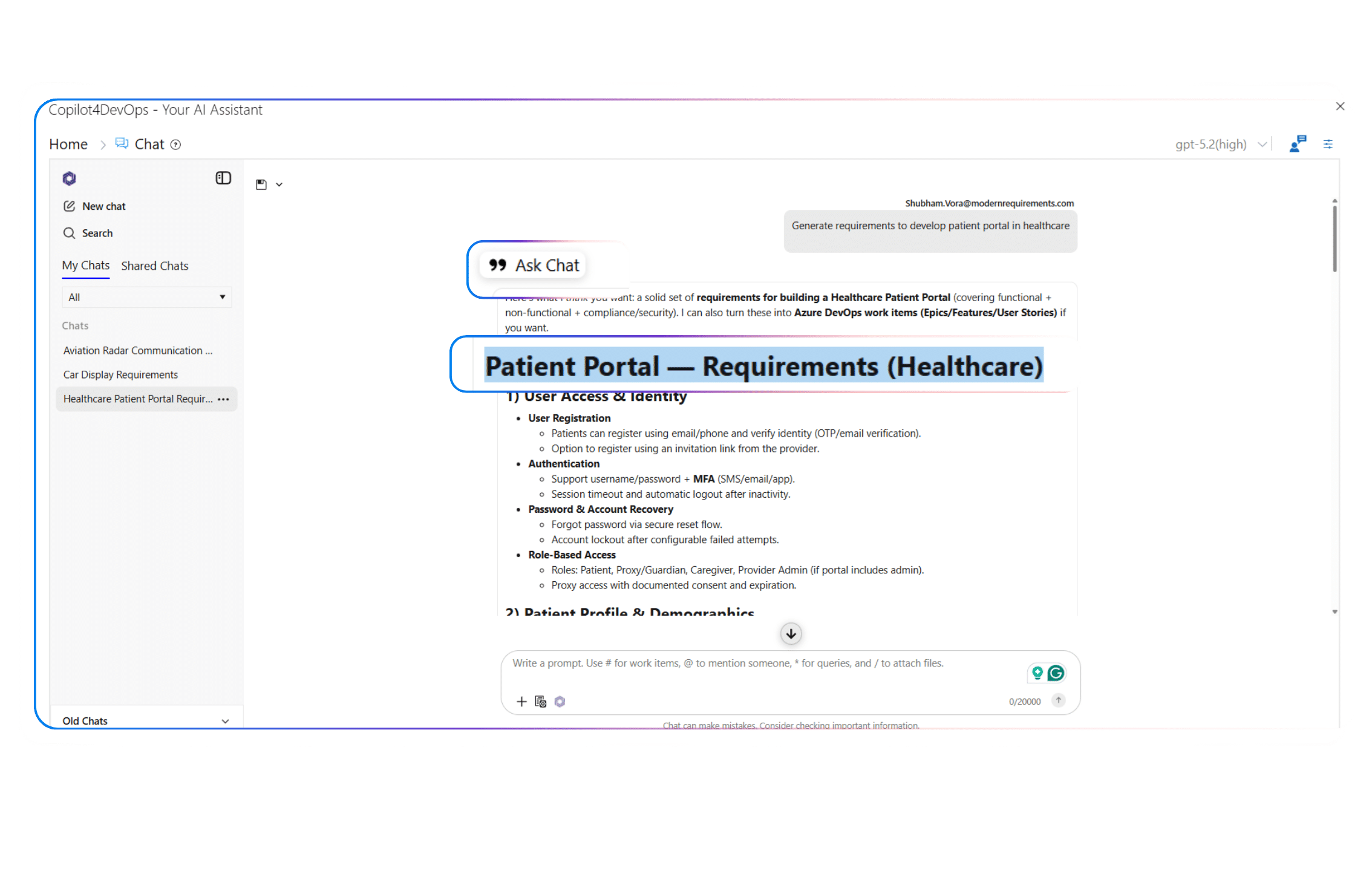
Highlight any text, and a small pop-up lets you tag it for the next question. The system automatically uses that reference to give you a more relevant answer.
Rewrite prompt
Not sure how to phrase your request?
Use the “Rewrite Prompt” option, which helps you refine the prompt using an AI. With a refined prompt, teams can get better outputs.
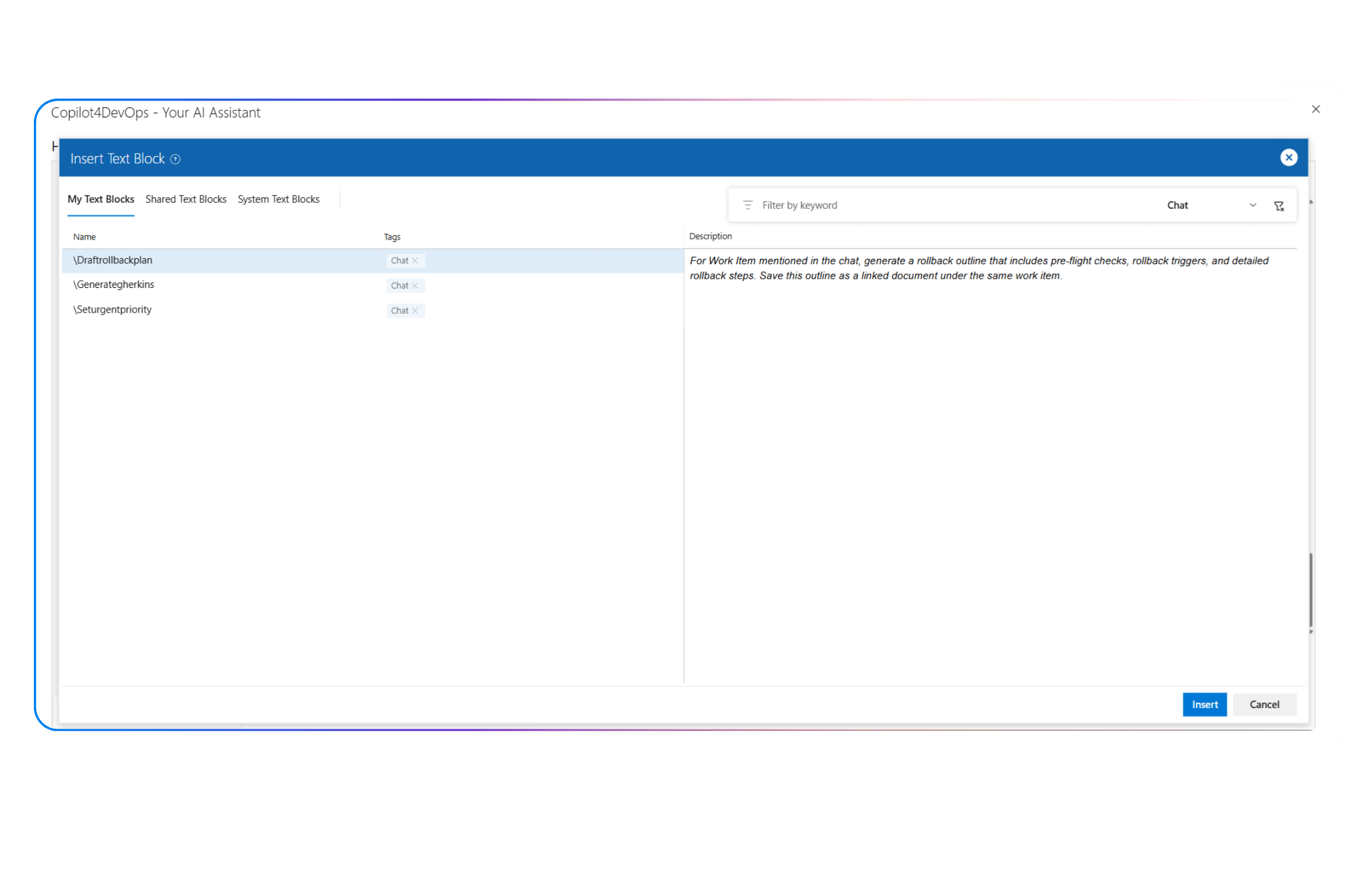
Text blocks
Tired of retyping the same instructions?
Save them as Text Blocks. Later, teams can import text blocks into the prompt area whenever they need. This helps in generating consistent output and saves time.
Top use cases across different industries
Creating requirements in bulk for medical device development
A product owner working in the healthcare team that develops different medical devices is required to list down all requirements. They collect requirements and feedback from doctors, patients, nurses, and other team members, then manually convert them into epics, features, user stories, etc., and add them to Azure DevOps. This way, they spend lots of time creating requirements and might miss important requirements.
With AI Chat of Copilot4DevOps, they can provide feedback or meeting notes, policy documents, compliance lists, etc., as context for the AI. Then, they can ask it to extract all high-level requirements (epics) with proper titles and descriptions and insert them into the Azure backlog. Later, for each epic, they can generate features, user stories, and so on, and link them with epics as child work items. They can even generate multiple test cases for all user stories at once. So, AI chat is very helpful in managing Azure work items in bulk.
Reviewing and updating regulatory work items in Banking
In the baking software team, the project manager works with thousands of requirements tied to security, audits, compliance, features, etc. Manually tracking the progress of each requirement and updating or reviewing them can be a challenging task.
By using AI chat within Azure DevOps, they can write a simple prompt, such as “Give me a status of all work items tied to sprint 1”, and it lists down all requirements with status. They can also ask to set priority to 1 for all work items tagged as KYC to update work items in bulk. Furthermore, to review work items in bulk, the project manager can type a prompt like, “Review all work items tied to fixed deposit creation and list down gaps or risks,” and it gives a proper risk analysis report. This saves project managers hours of time and boosts their productivity.
Creating diagrams and documents for complex flight control features in Aerospace
Aerospace projects are always complex, and teams heavily rely on visuals and documentation. Architects usually switch between diagram tools and Azure DevOps, leading to version mismatches and missing references between diagrams and actual work items.
On the other hand, when teams use the AI chat of Copilot4DevOps, they can provide Azure work items as a reference, simply type a prompt according to needs, and it generates a diagram within seconds. Similarly, they can also ask to analyze the status of all work items of the current sprint and generate a project progress report. If you notice here, AI automatically filters Azure work items according to your prompt and takes them as a reference while generating reports.
Key benefits of using AI Chat in Copilot4DevOps
- Teams using AI Chat of Copilot4DevOps report up to 70% less time in backlog management.
- It reduces the planning and review cycles by nearly 60%, improving release readiness.
- Teams don’t need to switch between multiple tabs to perform actions on Azure work items.
- Multiple team members can work collaboratively by using shared chats.