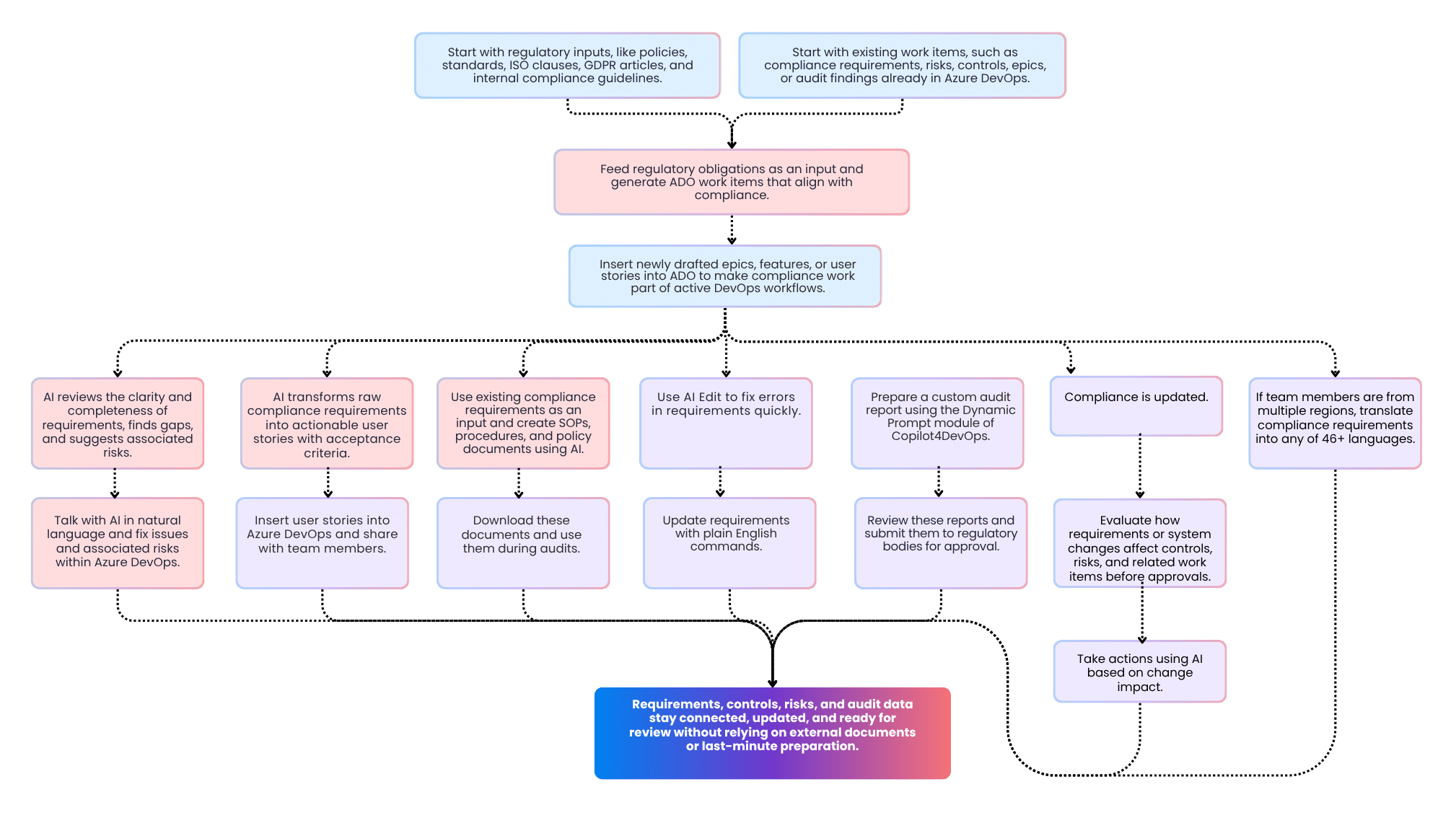
Bring compliance into your DevOps workflow using AI. Draft compliance requirements without gaps, convert them into actionable user stories, run compliance risk analysis, and validate coverage within Azure DevOps.
Every regulation imposes obligations that organizations must follow. While using Copilot4DevOps, compliance teams can provide those obligations to AI as an input context and prepare structured requirements like epics—reduces manual interpretation and speeds up requirement creation.
Identify compliance gaps with AI
Copilot4DevOps AI analyzes compliance requirements for clarity, missing controls, completeness, weak definitions, and unclear acceptance criteria before development starts—reducing issues during audit preparation.
AI to convert policies into user stories
Transform regulatory policies, standards, or control descriptions into user stories with acceptance criteria using AI and within the DevOps workflow—allowing compliance and development teams to work together.
Refine requirements based on regulatory updates
AI chat searches for regulatory changes and updates all relevant requirements directly into the Azure DevOps—keeps compliance aligned with evolving standards.
Translate compliance requirements globally
Copilot4DevOps translates compliance requirements into 46+ languages directly within ADO—allowing global teams to work together and ensure consistency across regions without manual translation effort.
Prepare audit reports with AI
Generate audit summaries, compliance reports, and supporting narratives using linked work items and AI—this reduces last-minute audit preparation effort and improves audit readiness.
Generate SOPs and policies using AI
Prepare SOPs, technical spec documents, and compliance documents with a consistent structure based on existing ADO requirements—reducing time spent on preparing repetitive documents.
Review the impact of change requests on compliance
Evaluate how requirements or design changes affect policies, controls, risks, and dependent work items using Impact Assessment—prevents missed compliance updates during change requests and release cycles.
Edit compliance requirements with AI
Edit compliance requirements with a single click directly within Azure DevOps—helping teams to remove errors from requirements.
Azure DevOps + Copilot4DevOps in action for Compliance teams
Industries
Built for compliance teams working in different industries
Healthcare and Medical Devices
Helps in adhering to compliance standards like ISO 13485, ISO 14971, and FDA 21 CFR Part 11 by generating and validating requirements with AI.
Banking and Financial Services
Banking teams can use Copilot4DevOps to draft software requirements adhering to regulatory standards, such as PCI DSS, DORA, and SOX. It also helps in validating compliance coverage in requirements.
Insurance and Risk Management
Handle frameworks like Solvency II and IFRS 17 by structuring requirements, analyzing risk coverage, and maintaining alignment between policies, controls, and implementation using AI within DevOps processes.
Government and Public Sector
Support regulatory standards such as NIST 800-53 and public sector governance policies by analyzing risk and gaps in requirements using AI and directly within Azure DevOps.
Aerospace and Defense
Helps to stay aligned with compliance standards like DO-178C for software systems and ARP4754 by drafting and analyzing requirements that support regulatory obligations.
Automotive and Functional Safety
Copilot4DevOps AI addresses automotive functional safety standards like ISO 26262 by defining safety goals and generating validation scenarios within Azure DevOps using AI assistance.
Technology and SaaS Platforms
Manage compliance with SOC 2, ISO 27001, and GDPR by structuring security requirements, validating control coverage, and preparing audit summaries within a unified DevOps workflow using AI.
Energy and Infrastructure
AI helps to stay aligned with energy standards, such as ISO 9001 for quality management and ISO 50001 for energy management, by structuring requirements according to defined obligations, assessing risk impact, and maintaining audit readiness across Azure DevOps projects.
Use Cases
Use cases of Copilot4DevOps for compliance teams
Draft ISO 13485 design control requirements
As a Quality & Compliance Manager in a medical device company, I use Copilot4DevOps AI’s Elicit feature to convert ISO 13485 obligations into actionable requirements and add them to Azure DevOps.
Validate SOC 2 control coverage across the backlog
Validate SOC 2 control coverage across the backlog
Assess the impact of PCI DSS updates on requirements
Assess the impact of PCI DSS updates on requirements
Translate compliance requirements for global teams
As a Regulatory Specialist, I take the help of AI to translate compliance requirements into multiple languages and share them with global teams working across the EU and APAC regions.
Create HIPAA compliance user stories for healthcare systems
As a Compliance Analyst in a healthcare project, I use AI within Azure DevOps for converting HIPAA security rules into actionable user stories that can be directly shared with developers to implement.
Generate test cases for ISO 26262 safety requirements
As a Functional Safety Engineer, I use Copilot4DevOps for generating test cases based on ISO 26262 functional safety requirements and insert them into Azure DevOps to share with QA teams.
Create SOPs for ISO 9001 process compliance
As a Quality Manager, I use AI to generate SOPs based on existing ISO 9001 requirements.
Analyze risk coverage in Solvency II requirements
As a Risk & Compliance Manager in insurance, I utilize AI for reviewing Solvency II requirements and finding gaps, risks, or weak control definitions.
Generate audit evidence summaries for SOC 2 audits
As an Internal Auditor, I use Copilot4DevOps to collect all evidence for preparing SOC 2 audits using AI. It analyzes all relevant work items and collects logs, what’s implemented, what’s not, version history, and other required things.
Bulk create ISO 27001 control requirements using AI Chat
As an Information Security Officer, I use AI Chat to brainstorm and create ISO 27001-related requirements in bulk with a single click.
Summarize all FDA 21 CFR Part 11 requirements
As a Compliance Manager, I use Copilot4DevOps to filter all requirements related to FDA 21 CFR Part 11 and summarize them. Then, I quickly review them and validate coverage manually.
Update all GDPR data processing requirements
As a Data Privacy Officer, I filter all GDPR data processing-related requirements using AI Chat and update their priority to 1 in bulk.
Elaborate ISO 14971 risk controls for engineering teams
As a Risk Manager in medical devices, I expand ISO 14971 control obligations into detailed and implementable requirements so that development teams can clearly understand the purpose.
Edit ISO 14971 risk controls
As a Risk Manager, I use the AI Edit feature of Copilot4DevOps to edit ISO 14971 risk controls by providing commands in plain English to AI.
Identify third-party compliance risks in vendor requirements
As a Vendor Risk Manager, I use AI Chat to review vendor-related requirements and identify gaps in security, data protection, and contractual compliance obligations.
Does Copilot4DevOps support regulated industries like healthcare or finance?
Yes. Copilot4DevOps is built to comply with standards such as SOC 2, the EU AI Act, etc., making it a reliable solution for regulatory industries like healthcare, banking, insurance, and government.
Is data from Azure DevOps used to train AI models?
No. Copilot4DevOps is SOC Type II compliant, which means it doesn’t store your data, share it with third-party apps, or use it for training AI models. Your data remains safe within your workspace.
Does Copilot4DevOps maintain audit-ready logs?
Yes, whenever Copilot4DevOps performs any action, such as creating or updating a work item, it adds comments like “This work item is created using AI”. This helps compliance teams while preparing audit reports.
Can we restrict AI usage for certain projects or teams?
Yes, admins in organizations can control where and how AI is used within Azure DevOps based on project, team, or compliance requirements.
Can Copilot4DevOps AI help during regulatory change updates?
When regulatory changes occur, AI chat within Copilot4DevOps can review all changes, analyze their impact on existing requirements, and, based on that, draft compliance requirements. So, it can help with end-to-end regulatory change management.
Does AI understand internal policies or only external regulations?
AI understands what you feed it as context. While drafting requirements, documents, diagrams, etc., teams can provide internal policies with compliance obligations as input, and AI can generate outputs aligned to those references.
Can Copilot4DevOps replace the compliance review process?
Teams can install the Copilot4DevOps extension within Azure DevOps in no time. That’s all needed for setup, and compliance teams can start using AI within their ADO workspace.
How quickly can a compliance team start using Copilot4DevOps?
Teams can install the Copilot4DevOps extension within Azure DevOps in no time. That’s all needed for setup, and compliance teams can start using AI within their ADO workspace.
Does Copilot4DevOps AI reduce dependency on multiple compliance tools?
Yes. With Copilot4DevOps, teams working within Azure DevOps can manage compliance directly where development occurs and keep everything connected. So, they don’t need to depend on other AI tools like ChatGPT or Claude.