





User Stories vs Requirements: Key Differences and Why Both Matter in Product Development

Copilot4DevOps - User Stories vs Requirements

In product development, teams often struggle with a fundamental question: Should we write user stories or requirements? The truth is, it’s not an either-or choice.

Although they both appear similar, they are not. User stories explain feature needs from the end-user’s perspective. On the other hand, requirements explain how the feature should be implemented and define system specifications.

When teams are confused about the distinction between user stories and requirements, it leads to miscommunication and scope creep. So, it is very critical to understand the clear differences between these two and how they work together.

Before we jump right into the differences between user stories and requirements, let’s understand both concepts clearly.

A Quick Definition of User Story

User stories are short, simple descriptions of a feature told from the perspective of the end-user (a person who desires a new capability). Its main focus is on what the user wants to achieve and why it matters for them.

A common format of a user story is: 

  • As a [type of user], I want [feature/system capability] so that [benefit/value].

For example:

  • “As a returning customer, I want to save my home and office address so that checkout can be quick.”

This defines what features returning customers need and why it is important for them.

What are the Requirements?

Requirements, on the other hand, describe what the system should do and how it should perform to fulfill the need defined in the user story format. There can be multiple types of requirements, including functional requirements, non-functional requirements, business requirements, etc.

Here is how requirements related to the user story explained in the previous example should look:

  • The system should allow saving the address only when the user is logged in.
  • The user should be able to save up to 10 different addresses.
  • During checkout, the system should show saved addresses automatically.

So, this states the exact behavior the system must follow to implement the feature demanded in the user story format.

In short, a user story captures user value and context. A requirement defines system behavior, rules, and constraints.

User Stories vs Requirements in Agile: Key Differences Explained

Before writing this section, we have gone through multiple Reddit and Quora threads to understand how business analysts, product managers, and other senior leaders differentiate user stories and requirements, and summarized them here:

Aspect User Stories Requirements
Core distinction Explains the features that users need and their benefits. Explains what the system should do and how to implement a particular feature.
Format and typical content Short and simple sentence written from the user’s perspective with an acceptance criteria. They are direct statements describing system behavior, rules to follow, or constraints.
Examples (illustrative) As a job finder, I want to search for jobs by keywords so that I can find relevant jobs.
  • The system should allow filtering jobs by keywords.
  • Most relevant jobs should appear at the top.
When to use each
  • During discovery
  • Backlog creation
  • Sprint planning
  •  
  • During design
  • Development
  • Testing
  • Compliance review
.
Primary audience
  • Product owners
  • Developers
  • Designers
  • Testers
  • Engineers
  • QA
  • Architects
  • Auditors
  • External stakeholders
Level of specificity and testability Acceptance criteria must be added to make it testable It should be written in such a way that it becomes testable without additional explanation
Practical checklist for teams
  • Is the user value clear?
  • Are acceptance criteria defined?
  • Is the rule measurable?
  • Can it be tested and reviewed later?

How User Stories and Requirements Work Together in the Product Development Process

Most blogs I’ve read on the internet say user stories are used in Agile (iterative development), and requirements are used with traditional models like waterfall. That’s not 100% true!

The most effective product development team doesn’t choose between them but uses both effectively. Teams create user stories during the discovery and planning phase, which helps teams in understanding user needs, setting priorities, and deciding what to build next. They use user stories to discuss scope with non-tech stakeholders.

Once user stories are approved to start development work, requirements come into the picture. They are used during design, development, and testing to define exact system behavior, rules, and constraints. Architects and engineers define requirements based on user stories and acceptance criteria.

When both are used properly together, user stories guide direction, and requirements provide control. It forms a complete and reliable product development process, and teams can ship products without slowing down delivery.

Challenges Teams Face When Managing User Stories and Requirements

Here are several challenges that teams face while managing requirements and user stories together:

  • Creating stories and requirements from scattered inputs: Teams often get scattered inputs about features in the form of documents, emails, meeting notes, or legacy specifications. Manually converting them into structured user stories or requirements is challenging and time-consuming. It can be error-prone, and sometimes, important context can be lost.
  • Maintaining traceability across work items: When requirements, test cases, user stories, etc., live in scattered tools, teams can’t trace how requirements are connected with user stories or test cases. This lack of visibility creates risk during development, testing, and release.
  • Ensuring consistent quality and structure: Some user stories miss acceptance criteria. Some requirements are vague or not testable. Reviews rely heavily on manual checks, which are slow and inconsistent across teams.
  • Managing change and ongoing updates: Requirements never stay constant as the product evolves. Without strong change impact assessment processes, it is hard to manage changes and ongoing updates.

To solve these challenges, teams should look for AI tools for requirements and user stories, which help in generating user stories, analyzing them for quality, and reducing manual efforts.

How Copilot4DevOps Helps Teams Create and Manage User Stories and Requirements in Azure DevOps

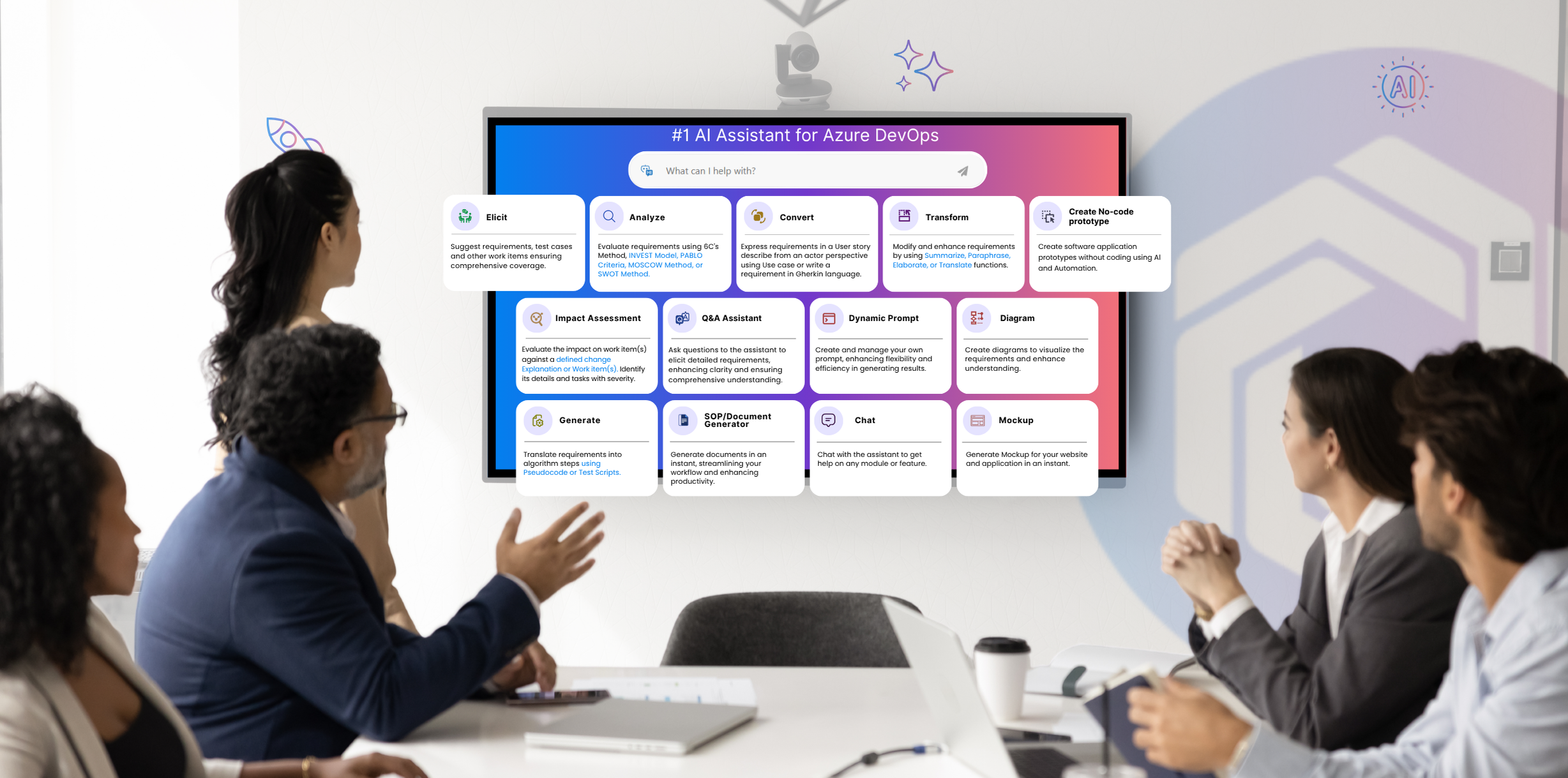
Copilot4DevOps is an AI assistant for requirements management that works directly within your Azure DevOps workspace as an extension. Here are some common features of Copilot4DevOps that help in managing requirements and user stories within ADO:

  • Elicit: It allows the generation of user stories and different types of requirements, including functional and non-functional requirements, directly from raw inputs, customer feedback, existing documents, or high-level requirements. It generates all user stories in a consistent format and ensures that edge cases are not missed. This saves 80% of the time of teams in drafting requirements.
  • SOP/Document generator: With this feature, teams can create requirements documents from existing ADO requirements using an AI. It inserts sections, subsections, diagrams, interactive UI, etc., into the document, which can be exported into the Microsoft Word or PDF format.
  • Analyze: It analyzes requirements and user stories against different evaluation frameworks, such as INVEST, PABLO Criteria, MoSCow, etc., using an AI and directly within Azure DevOps. This helps teams ensure requirements are consistent and meet quality criteria before any development starts.
  • Impact assessment: It uses AI to assess how changing a particular work item will affect other existing work items. So, teams can know the risks associated with a proposed change before moving a step forward.

This way, by utilizing AI tools for managing requirements and user stories, teams can boost their overall productivity and improve their project’s success rate.

Try it Yourself

Ready to transform your DevOps with Copilot4DevOps?

Get a free trial today.
Table of Contents

Table of Contents

In product development, teams often struggle with a fundamental question: Should we write user stories or requirements? The truth is, it’s not an either-or choice.

Although they both appear similar, they are not. User stories explain feature needs from the end-user’s perspective. On the other hand, requirements explain how the feature should be implemented and define system specifications.

When teams are confused about the distinction between user stories and requirements, it leads to miscommunication and scope creep. So, it is very critical to understand the clear differences between these two and how they work together.

Before we jump right into the differences between user stories and requirements, let’s understand both concepts clearly.

A Quick Definition of User Story

User stories are short, simple descriptions of a feature told from the perspective of the end-user (a person who desires a new capability). Its main focus is on what the user wants to achieve and why it matters for them.

A common format of a user story is: 

  • As a [type of user], I want [feature/system capability] so that [benefit/value].

For example:

  • “As a returning customer, I want to save my home and office address so that checkout can be quick.”

This defines what features returning customers need and why it is important for them.

What are the Requirements?

Requirements, on the other hand, describe what the system should do and how it should perform to fulfill the need defined in the user story format. There can be multiple types of requirements, including functional requirements, non-functional requirements, business requirements, etc.

Here is how requirements related to the user story explained in the previous example should look:

  • The system should allow saving the address only when the user is logged in.
  • The user should be able to save up to 10 different addresses.
  • During checkout, the system should show saved addresses automatically.

So, this states the exact behavior the system must follow to implement the feature demanded in the user story format.

In short, a user story captures user value and context. A requirement defines system behavior, rules, and constraints.

User Stories vs Requirements in Agile: Key Differences Explained

Before writing this section, we have gone through multiple Reddit and Quora threads to understand how business analysts, product managers, and other senior leaders differentiate user stories and requirements, and summarized them here:

Aspect User Stories Requirements
Core distinction Explains the features that users need and their benefits. Explains what the system should do and how to implement a particular feature.
Format and typical content Short and simple sentence written from the user’s perspective with an acceptance criteria. They are direct statements describing system behavior, rules to follow, or constraints.
Examples (illustrative) As a job finder, I want to search for jobs by keywords so that I can find relevant jobs.
  • The system should allow filtering jobs by keywords.
  • Most relevant jobs should appear at the top.
When to use each
  • During discovery
  • Backlog creation
  • Sprint planning
  •  
  • During design
  • Development
  • Testing
  • Compliance review
.
Primary audience
  • Product owners
  • Developers
  • Designers
  • Testers
  • Engineers
  • QA
  • Architects
  • Auditors
  • External stakeholders
Level of specificity and testability Acceptance criteria must be added to make it testable It should be written in such a way that it becomes testable without additional explanation
Practical checklist for teams
  • Is the user value clear?
  • Are acceptance criteria defined?
  • Is the rule measurable?
  • Can it be tested and reviewed later?

How User Stories and Requirements Work Together in the Product Development Process

Most blogs I’ve read on the internet say user stories are used in Agile (iterative development), and requirements are used with traditional models like waterfall. That’s not 100% true!

The most effective product development team doesn’t choose between them but uses both effectively. Teams create user stories during the discovery and planning phase, which helps teams in understanding user needs, setting priorities, and deciding what to build next. They use user stories to discuss scope with non-tech stakeholders.

Once user stories are approved to start development work, requirements come into the picture. They are used during design, development, and testing to define exact system behavior, rules, and constraints. Architects and engineers define requirements based on user stories and acceptance criteria.

When both are used properly together, user stories guide direction, and requirements provide control. It forms a complete and reliable product development process, and teams can ship products without slowing down delivery.

Challenges Teams Face When Managing User Stories and Requirements

Here are several challenges that teams face while managing requirements and user stories together:

  • Creating stories and requirements from scattered inputs: Teams often get scattered inputs about features in the form of documents, emails, meeting notes, or legacy specifications. Manually converting them into structured user stories or requirements is challenging and time-consuming. It can be error-prone, and sometimes, important context can be lost.
  • Maintaining traceability across work items: When requirements, test cases, user stories, etc., live in scattered tools, teams can’t trace how requirements are connected with user stories or test cases. This lack of visibility creates risk during development, testing, and release.
  • Ensuring consistent quality and structure: Some user stories miss acceptance criteria. Some requirements are vague or not testable. Reviews rely heavily on manual checks, which are slow and inconsistent across teams.
  • Managing change and ongoing updates: Requirements never stay constant as the product evolves. Without strong change impact assessment processes, it is hard to manage changes and ongoing updates.

To solve these challenges, teams should look for AI tools for requirements and user stories, which help in generating user stories, analyzing them for quality, and reducing manual efforts.

How Copilot4DevOps Helps Teams Create and Manage User Stories and Requirements in Azure DevOps

Copilot4DevOps is an AI assistant for requirements management that works directly within your Azure DevOps workspace as an extension. Here are some common features of Copilot4DevOps that help in managing requirements and user stories within ADO:

  • Elicit: It allows the generation of user stories and different types of requirements, including functional and non-functional requirements, directly from raw inputs, customer feedback, existing documents, or high-level requirements. It generates all user stories in a consistent format and ensures that edge cases are not missed. This saves 80% of the time of teams in drafting requirements.
  • SOP/Document generator: With this feature, teams can create requirements documents from existing ADO requirements using an AI. It inserts sections, subsections, diagrams, interactive UI, etc., into the document, which can be exported into the Microsoft Word or PDF format.
  • Analyze: It analyzes requirements and user stories against different evaluation frameworks, such as INVEST, PABLO Criteria, MoSCow, etc., using an AI and directly within Azure DevOps. This helps teams ensure requirements are consistent and meet quality criteria before any development starts.
  • Impact assessment: It uses AI to assess how changing a particular work item will affect other existing work items. So, teams can know the risks associated with a proposed change before moving a step forward.

This way, by utilizing AI tools for managing requirements and user stories, teams can boost their overall productivity and improve their project’s success rate.

Try it Yourself

Ready to transform your DevOps with Copilot4DevOps?

Get a free trial today.