



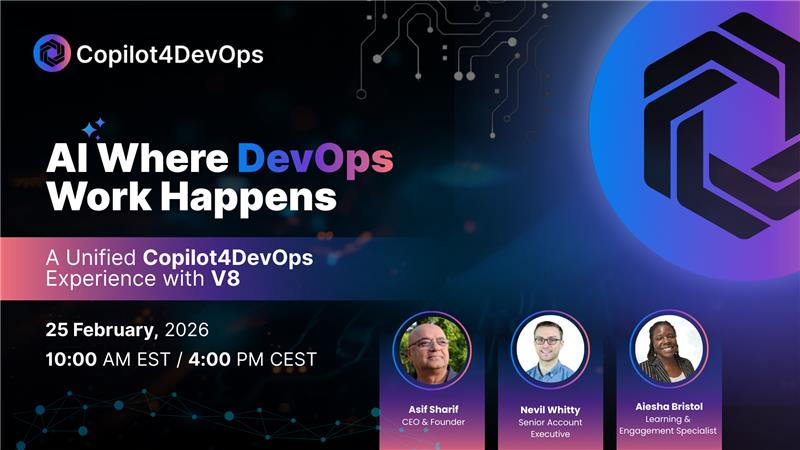
Copilot4DevOps V8 Unwrapped: What’s New & What’s Next

On-demand Webinar Replay

In this session, the team walks through Copilot4DevOps Version 8—focused on reducing context switching, improving work item quality, enabling team collaboration in AI, and grounding outputs using attachments / files / BYOD.

Why this session matters

Most teams adopting AI in DevOps still hit the same barriers:

  • AI doesn’t have enough context (docs, attachments, decisions in comments)
  • Governance & confidence gaps (readiness, risk, “is this ready to ship?”)
  • Friction + context switching (AI outside the place work happens)
  • Collaboration problems (AI output lives in silos)

V8 directly targets those adoption blockers by embedding Copilot4DevOps inside Azure DevOps boards + work items, and making AI outputs more repeatable, visible, and team-ready.

What we shipped in V8: practical AI where DevOps work happens

1) Copilot access from Boards + inside the Work Item editor

V8 adds two high-adoption entry points:

  • Launch Copilot directly from the board side panel
  • Open Copilot in a dedicated work item tab (so quality improvements happen where the work is authored)

This keeps users in-flow and reduces “jump out to chat / copy-paste” behavior.

2) Work Item Insights: readiness + risk, automatically

V8 introduces Work Item Insights that grade and summarize readiness signals like:

  • priority signals / blockers
  • traceability
  • effort / completion
  • quality + testing coverage
    …and provides views like compact report and cards for deeper detail.

Positioning: less “tribal knowledge,” more consistent, repeatable decision confidence.

3) Shared AI Chats that teams can actually collaborate in

Shared chats move from read-only to interactive collaboration, where:

  • chats can be moved into shared
  • multiple users can participate (with a clear “active user” control)

This makes AI outputs auditable and team-aligned instead of personal/hidden. (Transcript)

4) File + link upload everywhere (including Dynamic Prompt)

V8 expands “context injection” broadly:

  • upload from local device
  • pull work item attachments
  • use BYOD library
  • add web links
    …and this now includes Dynamic Prompt, which was heavily requested.

Supported file types called out in Q&A include PDF, DOC, PPT, Excel/CSV, JSON, YAML, XML, etc.

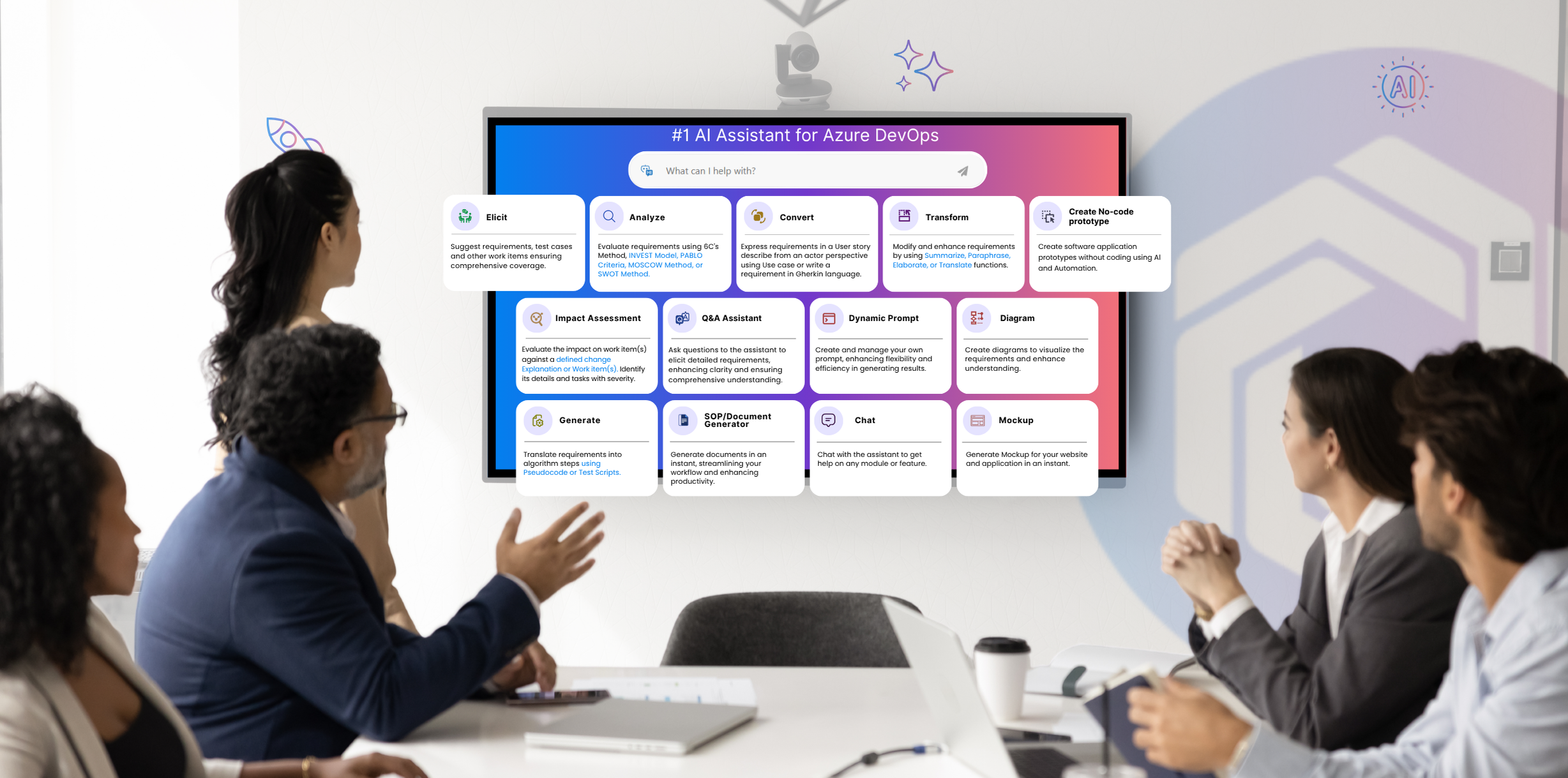
5) A redesigned dashboard that’s customizable + usage-driven

V8 refreshes the UI so teams can:

  • favorite/rearrange tools
  • see most-used tools float to the top
  • access grouped tool categories (Elicit/Analyze/Convert + visualization + advanced tools)

Goal: faster access and better adoption across roles.

6) Simplified model selection (choose by outcome: speed vs depth)

Instead of exposing technical model naming, V8 presents model choices in a more outcome-oriented way (speed vs depth), lowering the barrier for non-technical users.

7) BYOD moves to the project level (with team-level options discussed)

V8 shifts Bring Your Own Data so it can be configured per project, aligning context + governance to the team doing the work (instead of one org-wide bucket).

What’s ahead

From the transcript Q&A:

  • V9 is positioned as the release that introduces skills + agents support (more control, more extensibility), with talk of additional visibility into what the system is doing and broader artifact access.

(If you want, paste the exact “agents/skills” section you want emphasized and I’ll turn it into a tighter “What’s next” block.)

Who should watch this replay

This session is especially useful for teams who:

  • use Azure DevOps and want AI embedded into boards/work items (not separate tools)
  • need readiness/risk signals and more consistent work item quality
  • want collaborative AI (shared chats, reusable instructions/text blocks)
  • need AI grounded in attachments, docs, BYOD, and links for better outputs
Popular Webinars

Supercharge your DevOps workflow

Accelerate your development lifecycle with Copilot4DevOps

On-demand Webinar Replay

In this session, the team walks through Copilot4DevOps Version 8—focused on reducing context switching, improving work item quality, enabling team collaboration in AI, and grounding outputs using attachments / files / BYOD.

Why this session matters

Most teams adopting AI in DevOps still hit the same barriers:

  • AI doesn’t have enough context (docs, attachments, decisions in comments)
  • Governance & confidence gaps (readiness, risk, “is this ready to ship?”)
  • Friction + context switching (AI outside the place work happens)
  • Collaboration problems (AI output lives in silos)

V8 directly targets those adoption blockers by embedding Copilot4DevOps inside Azure DevOps boards + work items, and making AI outputs more repeatable, visible, and team-ready.

What we shipped in V8: practical AI where DevOps work happens

1) Copilot access from Boards + inside the Work Item editor

V8 adds two high-adoption entry points:

  • Launch Copilot directly from the board side panel
  • Open Copilot in a dedicated work item tab (so quality improvements happen where the work is authored)

This keeps users in-flow and reduces “jump out to chat / copy-paste” behavior.

2) Work Item Insights: readiness + risk, automatically

V8 introduces Work Item Insights that grade and summarize readiness signals like:

  • priority signals / blockers
  • traceability
  • effort / completion
  • quality + testing coverage
    …and provides views like compact report and cards for deeper detail.

Positioning: less “tribal knowledge,” more consistent, repeatable decision confidence.

3) Shared AI Chats that teams can actually collaborate in

Shared chats move from read-only to interactive collaboration, where:

  • chats can be moved into shared
  • multiple users can participate (with a clear “active user” control)

This makes AI outputs auditable and team-aligned instead of personal/hidden. (Transcript)

4) File + link upload everywhere (including Dynamic Prompt)

V8 expands “context injection” broadly:

  • upload from local device
  • pull work item attachments
  • use BYOD library
  • add web links
    …and this now includes Dynamic Prompt, which was heavily requested.

Supported file types called out in Q&A include PDF, DOC, PPT, Excel/CSV, JSON, YAML, XML, etc.

5) A redesigned dashboard that’s customizable + usage-driven

V8 refreshes the UI so teams can:

  • favorite/rearrange tools
  • see most-used tools float to the top
  • access grouped tool categories (Elicit/Analyze/Convert + visualization + advanced tools)

Goal: faster access and better adoption across roles.

6) Simplified model selection (choose by outcome: speed vs depth)

Instead of exposing technical model naming, V8 presents model choices in a more outcome-oriented way (speed vs depth), lowering the barrier for non-technical users.

7) BYOD moves to the project level (with team-level options discussed)

V8 shifts Bring Your Own Data so it can be configured per project, aligning context + governance to the team doing the work (instead of one org-wide bucket).

What’s ahead

From the transcript Q&A:

  • V9 is positioned as the release that introduces skills + agents support (more control, more extensibility), with talk of additional visibility into what the system is doing and broader artifact access.

(If you want, paste the exact “agents/skills” section you want emphasized and I’ll turn it into a tighter “What’s next” block.)

Who should watch this replay

This session is especially useful for teams who:

  • use Azure DevOps and want AI embedded into boards/work items (not separate tools)
  • need readiness/risk signals and more consistent work item quality
  • want collaborative AI (shared chats, reusable instructions/text blocks)
  • need AI grounded in attachments, docs, BYOD, and links for better outputs